Showing posts with label class12businessstudies. Show all posts

Sunday, 27 September 2015

NCERT Solutions for Class 12th: Ch 5 Organising

NCERT Solutions for Class 12th: Ch 4 Organising  Business Studies II

Exercises

Page No: 142

Multiple Choice

1. Which of the following is not an element of delegation?
(a) Accountability
(b) Authority
(c) Responsibility
(d) Informal organisation
► (d) Informal organisation

2. A network of social relationship that arise spontaneously due to interaction at work is called:
(a) Formal organisation
(b) Informal organisation
(c) Decentralisation
(d) Delegation
► (b) Informal organisation

3. Which of the following does not follow the scalar chain?
(a) Functional structure
(b) Divisional structure
(c) Formal organisation
(d) Informal organisation
► (d) Informal organisation

4. A tall structure has a
(a) Narrow span of management
(b) Wide span of management
(c) No span of management
(d) Less levels of management
► (a) Narrow span of management

5. Centralisation refers to
(a) Retention of decision making authority
(b) Dispersal of decision making authority
(c) Creating divisions as profit centers
(d) Opening new centers or branches
► (a) Retention of decision making authority

6. For delegation to be effective it is essential that responsibility be accompanied with necessary
(a) Authority
(b) Manpower
(c) Incentives
(d) Promotions
► (a) Authority

7. Span of management refers to
(a) Number of managers
(b) Length of term for which a manager is appointed
(c) Number of subordinates under a superior
(d) Number of members in top management
► (c) Number of subordinates under a superior

Page No: 143

8. The form of organisation known for giving rise to rumors is called
(a) Centralised organisation
(b) Decentralised organisation
(c) Informal organisation
(d) Formal organisation
► (c) Informal organisation

9. Grouping of activities on the basis of product lines is a partof
(a) Delegated organisation
(b) Divisional organisation
(c) Functional organisation
(d) Autonomous organisation
► (b) Divisional organisation

10. Grouping of activities on the basis of functions is a part of
(a) Decentralised organisation
(b) Divisional organisation
(c) Functional organisation
(d) Centralised organisation
► (b) Divisional organisation

Short Answer Type

1. Define ‘Organising’?

Answer

Organising can be defined as a process that initiates impleme­ntation of plans by clarifying jobs and working relationships and effectively deploying resources for attainment of identified and desired results.

2. What are the steps in the process of organising?

Answer

The steps in the process of organising are:

→ Identification and division of work:  The first step in the process of organising involves identifying and dividing the work that has to be done in accordance with previously determined plans.

→ Departmentalisation: Once work has been divided into small and manageable activities then those activities which are similar in nature are grouped together.

→ Assignment of duties: It is necessary to define the work of different job positions and accordingly allocate work to various employees.
→ Establishing reporting relation ships: Each individual should also know who he has to take orders from and to whom he is accountable.

3. Discuss the elements of delegation.

Answer

The elements of delegation are:

→ Authority: It refers to the right of an individual to command his subordinates and to take action within the scope of his position. It also refers to the right to take decisions inherent in a managerial position to tell people what to do and expect them to do it.

→ Responsibility: Responsibility is the obligation of a subor­dinate to properly perform the assigned duty. It arises from a superior – subordinate relationship because the subor­dinate is bound to perform the duty assigned to him by his superior.

→ Accountability: It implies being answerable for the final outcome. Once authority has been delegated and responsibility accepted, one cannot deny accountability.

4. What does the term ‘Span of management’ refer to?

Answer

Span of management refers to the number of subordinates that can be effectively managed by a superior. This determines the levels of management in the structure.

5. Under what circumstances would functional structure prove to be an appropriate choice?

Answer

If an organisation is large, has a diversified activities and operations require a high degree of specialisation then functional structure prove to be an appropriate choice.

6. Draw a diagram depicting a divisional structure.

Answer

Divisional Structure

7. Can a large sized organisation be totally centralised of decentralised? Give your opinion.

Answer

No, a large sized organisation can never be completely centralised or decent­ralised. As it grows in size and comp­lexity , there is a tendency to move towards decentralised decision making. This is because in large organisations those employees who are directly and closely involved with certain operations tend to have more knowledge about them than the top management which may only be indirectly associated with individual operations. Hence, there is a need for a balance between these co­existing forces. Thus, it can be said that every organisation will be characterised by both centralisation and decentralisation.

8. Decentralisation is extending delegation to the lowest level. Comment.

Answer

Decentralisation is extending delegation to the lowest level. Decentralisation refers to delegation of authority throughout all the levels of the organisation. Decision making authority is shared with lower levels and is consequently placed nearest to the points of action. Delegation refers to the downward transfer of authority from a superior to a subordinate. Delegation is a process and decentralisation is end result.
For Example: If a CEO of an organisation gives responsibility to production head for the production for specific units of products. The production head shares his responsibility of hiring workers with his managers. Managers shares his responsibility of supervising the workers with supervisors. Therefore, the delegation at each level leads to decentralisation.

Long Answer Type

1. Why is delegation considered essential for effective organising?

Answer

Delegation is considered essential for effective organising because:

→ Effective management: By empowering the employees, the managers are able to function more efficiently as they get more time to concentrate on important matters.

→ Employee development: As a result of delegation, employees get more opportunities to utilise their talent and this may give rise to latent abilities in them. It allows them to develop those skills which will enable them to perform complex tasks and assume those responsibilities which will improve their career prospects.

→ Motivation of employees: Delegation helps in developing the talents of the employees. It also has psychological benefits. Responsibility for work builds the self­esteem of an employee and improves his confidence.

→ Facilitation of growth: Delega­tion helps in the expansion of an organisation by providing a ready workforce to take up leading positions in new ventures. Also trained and experienced emp­loyees are able to play significant roles in the launch of new projects.

→ Basis of management hier­archy: Delegation of authority establishes superior subordinate relationships, which are the basis of hierarchy of management. It is the degree and flow of authority which determines who has to report to whom.

→ Better coordination: The elements of delegation, namely authority, responsibility and accountability help to define the powers, duties and answerability related to the various positions in an organisation which helps to avoid overlapping of duties and duplication of effort as it gives a clear picture of the work being done at various levels.

2. What is a divisional structure? Discuss its advantages and limitations.

Answer

Divisional structure refer to the organisation structure comprises of separate business units or divisions where each unit has a divisional manager has its authority and responsible for performance. Each  division  is  multifunctional because within each division func­tions like production, marketing,
finance, purchase etc, are performed together to achieve a common goal. Each division is self-contained as it develops expertise in all functions related to a product line. For example, a large company may have divisions like cosmetics, clothing etc.

The advantages of divisional structure are:

→ Product specialisation helps in the development of varied skills in a divisional head and this prepares him for higher positions. This is because he gains experience in all functions related to a particular product.

→ Divisional heads are accountable for profits, as revenues and costs related to different departments can be easily identified and assigned to them. This provides a proper basis for performance measurement. It also helps in fixation of respons­ibility in cases of poor performance of the division and appropriate remedial action can be taken.

→ It promotes flexibility and initiative because each division functions as an autonomous unit which leads to faster decision making.

→ It facilitates expansion and growth as new divisions can be added without interrupting the existing operations by merely adding another divisional head and staff for the new product line.
The limitations of divisional structure are:

→ Conflict may arise among different divisions with reference to allocation of funds and further a particular division may seek to maximise its profits at the cost of other divisions.

→ It may lead to increase in costs since there may be a duplication of activities across products. Providing  each  division  with separate set of similar functions increases expenditure.

→ It provides managers with the authority to supervise all activities related to a particular division. In
course of time, such a manager may gain power and in a bid to assert his independence may ignore organisational interests.

3. Decentralisation is an optional policy. Explain why an organisation would choose to be decentralised.

Answer

Decentralisation is an optional policy because it is on the top management of an organisation how much power and work they want to share with the lower levels. An organisation would choose to be decentralised because of the following advantages:

→ Develops initiative among subordinates: Decentralisation helps to promote self­reliance and confidence amongst the subordinates because when lower managerial levels are given freedom to take their own decisions they learn to depend on their own judgment. It helps to identify those executives who have the necessary potential to become dynamic leaders.

→ Develops managerial talent for the future: Decentralisation gives subordinates a chance to prove their abilities and creates a reservoir of qualified manpower who can be considered to fill up more challenging positions

→ Quick decision making: It helps in making decisions process quick since decisions are taken at levels which are nearest to the points of action and there is no requirement for approval from many levels, the process is much faster. There are also less chances of information getting distorted because it doesn’t have to go through long channels.

→ Relief to top management: Decentralisation leaves the top management with more time which they can devote to important policy decisions rather than occupying their time with both policy as well as operational decisions.

→ Facilitates growth: Decentrali­sation gives greater autonomy to the lower levels of management as well as divisional or departmental heads that allows them to function in a manner best suited to their department and generates a sense of competition amongst the departments which ultimately leads to increase in productivity levels also the organisation is able to generate more returns which can be used for expansion purposes.

→ Better control: Decentralisation makes it possible to evaluate performance at each level and the departments can be individually held accountable for their results. It compels the management to innovative performance measurement systems.

4. How does informal organisation support the formal organisation?

Answer

Informal organisation emerges from within the formal organisation when people interact beyond their officially defined roles. It support the formal organisation by providing

→ Faster communication: Informal organisation leads to faster spread of information as well as quick feedback as prescribed lines of communication are not followed.

→ Social Satisfaction: It helps to fulfill the social needs of the members and allows them to find like minded people. This enhances their job satisfaction since it gives them a sense of belongingness in the organisation.

→ Organisational objectives: It contributes towards fulfillment of organisational objectives by compensating for inadequacies in the formal organisation. For example, employees reactions towards plans and policies can be tested through the informal network.

5. Distinguish between centralisation and decentralisation.

Answer

Basis
Centralisation
Decentralisation
AuthorityThe decision ­making authority is retained by higher levels of management.The decision ­making authority is delegated to lower levels of management.
BurdenMore burden on top level managers.Less burden on the top level managers.
Scope of DelegationScope of delegation is limited as power is concentrated in a few hands.Wider scope of delegation as authority can be transferred.
Decision makingThe decision making process is slow as the power lies only with the top management.The decision making process is s as the power lies only with the top management.
Subordinates roleThe subordinate don't get any chance to decide as all things are pre-decided by top level management.The subordinates get a chance to decide and act independently which develops skills and their managerial abilities.

Page No: 144

6. How is a functional structure different from a divisional structure?

Answer

Basis
Functional Structure
Divisional Structure
FormationIts formation is based on functionsIts formation is based on product lines and is supported by functions.
SpecialisationFunctional specialisation. Product specialisation.
ResponsibilityDifficult to fix on a department.Easy to fix responsibility for performance.
Managerial DevelopmentDifficult, as each functional manager has to report to the top management.Easier, as autonomy and the chance to perform multiple functions helps in managerial development.
Cost Functions are not duplicated hence economicalDuplication of resources in various departments, hence costly.
CoordinationDifficult for a multi­ product company.Easy, because all functions related to a particular
product are integrated in one department.

Application Type

1. Neha runs a factory wherein she manufactures shoes. The business has been doing well and she intends to expand by diversifying into leather bags as well as western formal wear thereby making her company a complete provider of corporate wear. This will enable her to market her business unit as the one stop for working women. Which type of structure would you recommend for her expanded organisation and why?

Answer

Divisional Structure is recommended for expanded organisation because the factory will manufacture three product. By this structure she may avail the benefits of products specialisation. There should be three divisions, one for each product.  She can ascertain the performance of each product individually. Accordingly, she may plan and take decisions quickly.

2. The production manager asked the foreman to achieve a target production of 200 units per day, but he doesn't give him the authority to requisition tools and materials from the stores department. Can the production manager blame the foreman if he is not able to achieve the desired target? Give reasons.

Answer

No, the production manager can't blame the foreman if he is not able to achieve the desired target because foreman was only given responsibility not authority. There should be balance between authority and responsibility. If responsibility is given then authority for fulfilling that responsibility must be given otherwise the work can't be completed.

3. A manager enhances the production target from 500 units to 700 units per month but the authority to draw raw material was not given by him. The production manager could not achieve the revised production target. Who is responsible and which principle was violated?

Answer

The manager would be responsible for non-achievement of the revised production target and principle of authority responsibility was violated.

4. A company has its registered office in Delhi, manufacturing unit at Gurgaon and marketing and sales department at Faridabad. The company manufactures the consumer products. Which type of organisational structure should it adopt to achieve its target?

Answer

The company should adopt functional organisational structure to achieve its target as it is performing different functions in different areas. This will help in improving managerial skill and give control over various activities. The departmentalisation make clear division of activities. Also, it will be economical as no duplication will take place and promote specialisation in functions.

Case Study

1. A company, which manufactures a popular brand of toys, has been enjoying good market reputation. It has a functional organisational structure with separate departments for Production, Marketing, Finance, Human Resources and Research and Development. Lately to use its brand name and also to cash on to new business opportunities it is thinking to diversify into manufacture of new range of electronic toys for which a new market is emerging.

Questions
Prepare a report regarding organisation structure giving concrete reasons with regard to benefits the company will derive from the steps it should take.

Answer

The company should shift from functional structure to divisional structure as the company is now diversifying by adding a new product line. By this structure, the performance of each product i.e., simple toys and electronic toys can be easily ascertained. Also, decision making will become faster.

Page No: 145

2. A company manufacturing sewing machines set up in 1945 by the British promoters follows formal organisation culture in totality. It is facing lot of problems in delays in decision­ making. As the result it is not able to adapt to changing business environment. The work force is also not motivated since they cannot vent their grievances except through formal channels, which involve red tape. Employee turnover is high. Its market share is also declining due to changed circumstances and business environment.

Questions
You are to advise the company with regard to change it should bring about in its organisation structure to overcome the problems faced by it. Give reasons in terms of benefits it will derive from the changes suggested by you. In which sectors can the company diversify keeping in mind the declining market for the product the company is manufacturing?

Answer

The company need to change complete formal organisation culture and accept some informal structure. The management should encourage employees to interact and socialise with each other. This will help the company in following ways.
• Information spreads faster as prescribed lines of communication are not followed.
• It gives them a sense of belongingness in the organisation and give more satisfied workforce.
• It helps in achievement of organisational objectives in better manner.

3. A company X limited manufacturing comsetics, which has enjoyed a pre-eminent position in business, has grown in size. Its business was very good till 1991. But after that, new liberalised environment has seen entry of many MNC’s in the sector.
With the result the market share of X limited has declined. The company had followed a very centralised business model with directors and divisional heads making even minor decisions. Before 1991, this business model had served the company very well as consumers has no choice. But now the company is under pressure to reform.

Question 
What organisation structure changes should the company bring about in order to retain its market share? How will the changes suggested by you help the firm? Keep in mind that the sector in which the company is FMCG.

Answer

The company needs to shift towards decentralisation as the company's business has grown in size. This will helps the company in following manner:
• Minor decisions will be taken by the lower level managers which gives enough time to the higher officials to think of better policies, strategies to handle the changes in the changing environment.
• It also develops managerial talent for future.
• It leads to quick decision making as decisions are taken at levels which are nearest to the points of action and there is no requirement for approval from many levels,

Go To Chapters

Tuesday, 18 August 2015

NCERT Solutions for Class 12th: Ch 4 Planning

NCERT Solutions for Class 12th: Ch 4 Planning Business Studies II

Exercises

Page No: 110

Short Answer Type

1. What are the main points in the definition of planning.

Answer

The main points in the definition of planning are:
• It means deciding in advance what to do and how to do.
• A basic managerial function.
• It requires taking decisions since it involves making a choice from alternative courses of action.
• It involves setting objectives and developing appropriate courses of action to achieve these objectives.
• It has to have a given time frame.

2. How does planning provide direction?

Answer

Planning provide direction by stating in advance how work is to be done. It ensures that the goals or objectives are clearly stated so that they act as a guide for deciding what action should be taken and in which direction. If goals are well defined, employees are aware of what the organisation has to do and what they must do to achieve those goals.

Page No: 111

3. Do you think planning can work in a changing environment?

Answer

No, planning may not work in a changing environment because it becomes difficult to accurately assess future trends in the environment if economic policies are modified or political conditions in the country are not stable or there is a natural calamity. Competition in the market can also upset financial plans, sales targets may have to be revised and, accordingly, cash budgets also need to be modified since they are based on sales figures. Planning cannot foresee everything and thus, there may be obstacles to effective planning.

4. If planning involves working out details for the future, why does it not ensure success?

Answer

Planning does not guarantee success. The success of an enterprise is possible only when plans are properly drawn up and implemented. Any plan needs to be translated into action or it becomes meaningless. Managers have a tendency to rely on previously tried and tested successful plans. It is not always true that just because a plan has worked before it will work again. Besides, there are so many other unknown factors to be considered. This kind of complacency and false sense of security may actually lead to failure instead of success.

5. Why are rules considered to be plans?

Answer

Rules are specific statements that inform what is to be done. They do not allow for any flexibility or discretion. It reflects a managerial decision that a certain action must or must not be taken. They are usually the simplest type of plans because there is no compromise or change unless a policy decision is taken.

6. What kind of strategic decisions are taken by business organisations.

Answer

Major strategic decisions will include decisions like whether the organisation will continue to be in the same line of business, or combine new lines of activity with the existing business or seek to acquire a dominant position in the same market.

Long Answer Type

1. Why is it that organisations are not always able to accomplish all their objectives?

Answer

For accomplishment of objectives an organisation make plans. However, planning also has a set of limitations therefore organisations are not always able to accomplish all their objectives. The limitations are:

→ Rigidity: A well-defined plan is drawn up with specific goals to be achieved within a specific time frame. These plans then decide the future course of action and managers may not be in a position to change it. This kind of rigidity in plans may create difficulty.
→ Planning may not work in a dynamic environment: The business environment is dynamic, nothing is constant. Planning cannot foresee everything and thus, there may be obstacles to effective planning. The  organisation has to constantly adapt itself to changes.

→ Planning reduces creativity: Planning is done by the top management. Usually the rest of the members just implements these plans. As a consequence, middle management and other decision makers are neither allowed to deviate from plans nor are they permitted to act on their own. Thus, planning in a way reduces creativity since people tend to think along the same lines as others.

→ Planning involves huge costs: Formulation of plans involves huge costs. Detailed plans require scientific calculations to ascertain facts and figures also number of incidental costs as well, like expenses on boardroom meetings, discussions with professional experts and preliminary investigations to find out the viability of the plan.. The costs incurred sometimes may not justify the benefits derived from the plans.

→ Planning is a time-consuming process: Sometimes plans to be drawn up take so much of time
that there is not much time left for their implementation.

→ Planning does not guarantee success: The success of an enterprise is possible only when plans are properly drawn up and implemented. Any plan needs to be translated into action or it becomes meaningless. Managers have a tendency to rely on previously tried and tested successful plans.It is not always true that just because a plan has worked before it will work again. Besides, there are so many other unknown factors to be considered. This kind of complacency and false sense of security may actually lead to failure instead of success.

2. What are the main features to be considered by the management while planning?

Answer

The  features to be considered by the management while planning are:

→ Focus on Objectives: Specific goals are set out in the plans along with the activities to be undertaken to achieve the goals. Thus, planning is purposeful. Planning has no meaning unless it contributes to the achievement of predetermined organisational goals.

→ Planning is a primary function of management: Planning lays down the base for other functions of management. All other managerial functions are performed within the framework of the plans drawn. Thus, planning precedes other functions.

→ Planning is pervasive: Planning is required at all levels of management as well as in all departments of the organisation. It is not an exclusive function of top management nor of any particular department. But the scope of planning differs at different levels and among different departments.

→ Planning is continuous: Plans are prepared for a specific period of time, may be for a month, a quarter, or a year. At the end of that period there is need for a new plan to be drawn on the basis of
new requirements and future conditions. Hence, planning is a continuous process.

→ Planning is futuristic: Planning essentially involves looking ahead and preparing for the future. The purpose of planning is to meet future events effectively to the best advantage of an organisation. It implies peeping into the future, analysing it and predicting it. Planning is, therefore, regarded as a forward looking function based on forecasting.

→ Planning  involves  decision making: The need for planning arises only when alternatives are available. Planning, thus, involves thorough examination and evaluation of each alternative and choosing the most appropriate one.

→ Planning is a mental exercise: Planning requires application of the mind involving foresight, intelligent imagination and sound judgment. It is basically an intellectual activity of thinking rather than doing, because planning determines the action to be taken. However, planning requires logical and systematic thinking rather than guess work or wishful thinking.

3. What are the steps taken by management in the planning process?

Answer

The steps taken by management in the planning process are:

→ Setting Objectives: The first and foremost step is setting objectives. Objectives or goals specify what the organisation wants to achieve. Objectives should be stated clearly for all departments, units and employees. Managers must understand how their actions contribute to achieving objectives. Objectives give direction to all departments. If the end result is clear it becomes easier to work towards the goal.

→ Developing Premises: Planning is concerned with the future which is uncertain and every planner is using conjecture about what might happen in future. Therefore, the manager is required to make certain assumptions about the future which is called premises. Assumptions are the base material upon which plans are to be drawn. The base material may be in the form of forecasts, existing plans or any past information about policies.

→ Identifying alternative courses of action: There may be many ways to act and achieve objectives. All the alternative courses of action should be identified. The course of action which may be taken could be either routine or innovative.

→ Evaluating alternative courses: The next step is to weigh the pros and cons of each alternative. The positive and negative aspects of each proposal need to be evaluated in the light of the objective to be achieved through detailed calculations of earnings, earnings per share, interest, taxes, dividends are made and decisions taken. Alternatives are evaluated in the light of their feasibility and consequences.

→ Selecting an alternative: The best plan has to be adopted and implemented. The ideal plan, of course, would be the most feasible, profitable and with least negative consequences. Subjectivity and the manager’s experience, judgement and at times, intuition play an important part in selecting the most viable alternative. Sometimes, a combination of plans may be selected instead of one best course.

→ Implementing the plan: The step is concerned with putting the plan into action, i.e., doing what is required. For example, if there is a plan to increase production then more labour, more machinery will be required. This step would also involve organising for labour and purchase of machinery.

→ Follow-up action: To see whether plans are being implemented and activities are performed according to schedule is also part of the planning process. Monitoring the plans is equally important to ensure that objectives are achieved.
4. Is planning actually worth the huge costs involved? Explain.

Answer

Planning is an essential function of organisation despite huge costs involved. The below points detailed the benefits of planning:

→ Planning provides directions: By stating in advance how work is to be done planning provides direction for action. Planning ensures that the goals or objectives are clearly stated so that they act as a guide for deciding what action should be taken and in which direction. If goals are well defined, employees are aware of what the organisation has to do and what they must do to achieve those goals. Departments and individuals in the organisation are able to work in coordination.

→ Planning reduces the risks of uncertainty: Planning is an activity which enables a manager to look ahead and anticipate changes. By deciding in advance the tasks to be performed, planning shows the way to deal with changes and uncertain events.

→ Planning reduces overlapping and wasteful activities: Planning serves as the basis of coordinating the activities and efforts of different divisions, departments and individuals. It helps in avoiding confusion and misunderstanding. Since planning ensures clarity in thought and action, work is carried on smoothly without interruptions. Useless and redundant activities are minimised or eliminated.

→ Planning promotes innovative ideas: Since planning is the first function of management, new ideas can take the shape of concrete plans. It is the most challenging activity for the management as it guides all future actions leading to growth and prosperity of the business.
→ Planning facilitates decision making: Planning helps the manager to look into the future and make a choice from amongst various alternative courses of action. The manager has to evaluate each alternative and select the most viable proposition. Planning involves setting targets and predicting future conditions, thus helping in taking rational decisions.

→ Planning establishes standards for controlling: Planning involves setting of goals. The entire managerial process is concerned with accomplishing predetermined goals through planning, organising, staffing, directing and controlling. Planning provides the goals or standards against which actual performance is measured. By comparing actual performance with some standard, managers can know whether they have actually been able to attain the goals.

Go To Chapters

Wednesday, 12 August 2015

NCERT Solutions for Class 12th: Ch 3 Business Environement

NCERT Solutions for Class 12th: Ch 2 Business Environement  Business Studies II

Page No: 92

Exercises

Multiple Choice

1. Which of he following does not characterise the business environment?
(a) Uncertainty
(b) Employees
(c) Relativity
(d) Complexity
► (b) Employees

2. Which of the following best indicates the importance of business environment?
(a) Identification
(b) Improvement in performance
(c) Coping with rapid changes
(d) All of them
► (d) All of them

3. Which of the following is an example of social environment?
(a) Money supply in the economy
(b) Consumer Protection Act
(c) The Constitution of the country
(d) Composition of family
► (d) Composition of family

4. Liberalisation means
(a) Integration among economies
(b) Reduced government controls and restrictions
(c) Policy of planned disinvestments
(d) none of them
► (b) Reduced government controls and restrictions

Page No: 93

5. Which of the following does not explain the impact of Government policy changes on business and industry?
(a) More demanding customers
(b) Increasing competition
(c) Change in agricultural prices
(d) Market orientation
► (c) Change in agricultural prices

Short Answer Type

1. What do you understand by business environment?

Answer

The business environment means the sum total of all individuals, institutions and other forces that are outside the control of a business enterprise but that may affect its performance. The economic, social, political, technological and other forces which operate outside a business enterprise are part of its environment also the individual consumers or competing enterprises as well as the governments, consumer groups, competitors, courts, media and other institutions working outside an enterprise constitute its environment.

2. Why it is important for business enterprises to understand their environment? Explain briefly.

Answer

It is important for business enterprises to understand their environment because:

→ It enables the firm to identify opportunities  and  getting the first mover advantage: Environment provides numerous opportunities for business success. Early identification of opportunities helps an
enterprise to be the first to exploit them instead of losing them to competitors.

→ It helps the firm to identify threats and early warning signals: Besides opportunities, environment happens to be the source of many threats. Environmental awareness can help managers to identify various threats on time and serve as an early warning signal.

→ It helps in tapping useful resources:Environment is a source of various resources for running a business. To engage in any type of activity, a business enterprise assembles various resources called inputs like finance, machines, raw materials, power and water, labour, etc., from its environment including financiers, government and suppliers.

→ It helps in coping with rapid changes: Today’s business environment is getting increasingly dynamic where changes are taking place at a fast pace. In order to effectively cope with these significant changes, managers must understand and examine the environment and develop suit- able courses of action.

→ It helps in assisting in planning and policy formulation: Since environment is a source of both opportunities and threats for a business enterprise, its understanding and analysis can be the basis for deciding the future course of action (planning) or training guidelines for decision making (policy).

→ It helps in improving performance: Many studies reveal that the future of an enterprise is closely bound up with what is happening in the environment. And, the enterprises that continuously monitor their environment and adopt suitable business practices are the ones which not only improve their present performance but also continue to succeed in the market for a longer period.

3. Mention the various dimensions of business environment.

Answer

The various dimensions of business environment are:

→ Economic Environment: This consists of interest rates, inflation rates, changes in disposable income of people, stock market indices and the value of rupee that can affect management practices in a business enterprise.

→ Social Environment: It include the social forces like customs and traditions, values, social trends, society’s expectations from business, etc.

→ Technological  Environment: It includes forces relating to scientific improvements and innovations which provide new ways of producing goods and services and new methods and techniques of operating a business.

→ Political Environment: Political environment includes political conditions such as general stability and peace in the country and specific attitudes that elected government representatives hold towards business.

→ Legal Environment: Legal environment includes various legislations passed by the Government administrative orders issued by government authorities, court judgments as well as the decisions rendered by various commissions and agencies at every level of the government - centre, state or local.

4. Briefly explain the following:
(a) Liberalisation
(b) Privatisation
(c) Globlisation

Answer

(a) Liberalisation: It means liberalising the business andindustry from all unnecessary controls and restrictions of the government in the form of licenses, permits and quotas. In India, liberalisation of industries initiated in 1991.

(b) Privatisation: It is a set of economic reforms aimed at giving greater role to the private sector in the nation building process and reducing the involvement of public sector. To achieve this, the government redefined the role of the public sector in the New Industrial Policy of 1991, adopted
the policy of planned disinvestments of the public sector and decided to refer the loss making and sick enterprises to the Board of Industrial and Financial Reconstruction.

(c) Globalisation: It means the integration of the various economies of the world leading towards the emergence of a cohesive global economy.

5. Briefly discuss the impact of Government policy changes on business and industry.

Answer

The impact of Government policy changes on business and industry are:

→ Increasing competition: The competition has increased due to entry of new players due to liberalisation and globalisation.

→ More demanding customers: Customers today have become more demanding because they are well-informed also increased competition in the market gives the customers wider choice.

→ Rapidly changing technological environment: The rapidly changing technological environment creates tough challenges before smaller firms.

→ Necessity for change: After 1991, the market forces have become unstable as a result of which the enterprises have to continuously modify their operations.

→ Need for developing human resource: The new market conditions require people with higher competence and greater commitment. Hence the need for developing human resources.

→ Market orientation: There is a shift to market orientation in as much as the firms have to study and analyse the market first and produce goods accordingly.

→ Loss of budgetary support to the public sector: The public sector undertakings have realised that in order to survive and grow, they will have to be more efficient and generate their own resources for the purpose.

Long Answer Type

1. How would you characterise business environment? Explain, with examples, the difference between general and specific environment.

Answer

Characteristics of business environment are:

→ Totality of external forces: Business environment is the sum total of all things external to business firms and, as such, is aggregative in nature.

→ Inter-relatedness: Different elements or parts of business environment are closely inter-related. For example, increased life expectancy of people and increased awareness for health care have increased the demand for many health products and services like diet Coke, fat-free cooking oil, and health resorts.

→ Dynamic nature: Business environment is dynamic in that it keeps on changing whether in terms of technological improvement, shifts in consumer preferences or entry of new competition in the market.

→ Uncertainty: Business environment is total of different interrelated and dynamic forces. Thus, it is very difficult to predict future happenings, especially when environment changes are taking place too frequently as in the case of information technology or fashion industries.

→ Complexity: Business environment consists of numerous interrelated and dynamic conditions or forces which arise from different sources, it becomes difficult to comprehend at once what exactly constitutes a given environment.

→ Relativity: Business environment is a relative concept since it differs from country to country and even region to region. For example: Political conditions in the USA, differ from those in China or Pakistan.

Difference between general and specific environment: The general environment includes the economic, technological, sociocultural, and political trends that indirectly affect all organizations. The specific environment includes the customer, competitor, supplier, industry regulation, and public pressure group trends that are unique to an industry and which directly affect how a company does business. All companies participate in the same general environment, but each company’s specific environment is distinct, based on its business and industry.

2. How would you argue that the success of a business enterprise is significantly influenced by its environment?

Answer

Any business enterprise do not exist in isolation. Each business firm is not an island unto itself, it exists, survives and grows within the context of the element and forces of its environment. A good understanding of environment by business managers enables them not only to identify and evaluate, but also to react to the forces external to their firms. A business environment role in success of a business enterprise can be understood by following points:

→ It enables the firm to identify opportunities and getting the first mover advantage: Early identification of opportunities helps an enterprise to be the first to exploit them instead of losing them to competitors. For example, Maruti Udyog became the leader in the small car market because it was the first to recognise the need for small cars in an environment of rising petroleum prices and a large middle class population in India.

→ It helps the firm to identify threats and early warning signals: Besides opportunities, environment happens to be the source of many threats. Environmental awareness can help managers to identify various threats on time and serve as an early warning signal. For example, if an Indian firm finds that a foreign multinational is entering the Indian market with new substitutes, it should act as a warning signal and they prepare themselves for by adopting measures such as improving the quality of the product, reducing cost of the production, engaging in aggressive advertising, and so on.

→ It helps in tapping useful resources: Environment is a source of various resources for running a business. To engage in any type of activity, a business enterprise  assembles  various resources  called inputs  like finance, machines, raw materials, power and water, labour, etc., from its environment including financiers,  government  and suppliers.

→ It helps in coping with rapid changes: Today’s business environment is getting increasingly dynamic where changes are taking place at a fast pace. All sizes and all types of enterprises are facing increasingly  dynamic environment. In order to effectively cope with these significant changes, managers must understand and examine the environment and develop suit- able courses of action.

→ It helps in assisting in planning and policy formulation: Since environment is a source of both opportunities and threats for a business enterprise, its understanding and analysis can be the basis for formulating the best possible policies to handle the future. For example, entry of new players in the market, which means more competition may make an enterprise think afresh about how to deal with the situation.

→ It helps in improving performance: Many studies reveal that the future of an enterprise is closely bound up with what is happening in the environment. The enterprises that continuously monitor their environment and adopt suitable business practices are the ones which not only improve their present performance but also continue to succeed in the market for a longer period.

3. Explain, with examples, the various dimensions of business environment.

Answer

The various dimensions of business environment are:

→ Economic Environment: Interest rates, inflation rates, changes in disposable income of people, stock market indices and the value of rupee are some of the economic factors that can affect management practices in a business enterprise. Short and long term interest rates significantly affect the demand for product and services.
For example, in case of construction companies and automobile manufacturers, low longer-term rates are beneficial because they result in increased spending by consumers for buying homes and cars on borrowed money.

→ Social Environment: This include the social forces like customs and traditions, values, social trends, society’s expectations from business, etc. Traditions define social practices that have lasted for decades or even centuries. 
For example, the celebration of Diwali, Id, Christmas, and Guru Parv in India provides significant financial opportunities for greetings card companies, sweets or confectionery manufacturers, tailoring outlets and many other related business.

→ Technological Environment: This includes forces relating to scientific improvements and innovations which provide new ways of producing goods and services and new methods and techniques of operating a business. 
For example, recent technological, advances in computers and electronics have modified the ways in which companies advertise their products. It is common now to see CD-ROM’s, computerised information counter, and Internet/World Wide Web multimedia pages highlighting the virtues of products.

→ Political Environment: Political environment includes political conditions such as general stability and peace in the country and specific attitudes that elected government representatives hold towards business. Political stability,builds up confidence among business people to invest in the long term projects for the growth of the economy while political instability can shake that confidence. 
For example, even after opening up of our economy in 1991, foreign companies found it extremely difficult to cut through the bureaucratic red tape to get permits for doing business in India.

→ Legal Environment: Legal environment includes various legislations passed by the Government administrative orders issued by government authorities, court judgments as well as the decisions rendered by various commissions and agencies at every level of the government— centre, state or local. It is imperative for the management of every enterprise to obey the law of the land.
For example, the advertisement of alcoholic beverages is prohibited. Advertisements, including packets of cigarettes carry the statutory warning ‘Cigarette smoking is injurious to health’.

4. What economic changes were initiated by the Government under the Industrial Policy, 1991? What impact have these changes made on business and industry?

Answer

The economic changes that were initiated by the Government under the Industrial Police, 1991 are:

→ The Government reduced the number of industries under compulsory licensing to six.
→ Many of the industries reserved for the public sector under the earlier policy, were dereserved. The role of the public sector was limited only to four industries of strategic importance.
→ Disinvestment was carried out in case of many public sector industrial enterprises.

→ Policy towards foreign capital was liberalised. The share of foreign equity participation was increased and in many activities 100 per cent Foreign Direct Investment (FDI) was permitted.

→ Automatic permission was now granted for technology agreements with foreign companies.

→ Foreign Investment Promotion Board (FIPB) was set up to promote and channelise foreign investment in India.
The impact which these changes made on business and industry are:

→ Increasing competition: As a result of changes in the rules of industrial licensing and entry of foreign  firms,  competition for Indian firms has increased especially in service industries like telecommunications, airlines, banking, insurance, etc. which were earlier in the public sector.

→ More demanding customers: Customers today have become more demanding because they are well-informed. Increased competition in the market gives the customers wider choice in purchasing better quality of goods and services.
→ Rapidly changing technological environment: Increased com- petition forces the firms to develop new ways to survive and grow in the market. New technologies make it possible to improve machines, process, products and services. The rapidly changing technological environment creates tough challenges before smaller firms.
→ Need for developing human resource: Indian enterprises have suffered for long with inadequately trained personnel. The new market conditions require people with higher competence and greater commitment. Hence the need for developing human resources.

→ Market orientation: Earlier firms used to produce first and go to the market for sale later. In other words, they had production oriented marketing operations. In a fast changing world, there is a shift to market orientation in as much as the firms have to study and analyse the market first and produce goods accordingly.
→ Loss of budgetary support to the public sector: The central government’s budgetary support for financing the public sector outlays has declined over the years. The public sector undertakings have realised that, in order to survive and grow, they will have to be more efficient and generate their own resources for the purpose.

5. What are the essential features of
(a) Liberalisation, (b) Privatisation and (c) Globalisation?

Answer

(a) Liberalisation: It means liberalising the business andindustry from all unnecessary controls and restrictions of the government in the form of licenses, permits and quotas. The essential features are:
→ Abolishing licensing requirement in most of the industries except a short list
→ Freedom in deciding the scale of business activities i.e., no restrictions on expansion or contraction of business activities
→ Removal of restrictions on the movement of goods and services
→ Freedom in fixing the prices of goods services,
→ Reduction in tax rates and lifting of unnecessary controls over the economy,
→ Simplifying procedures for imports and experts
→ Making it easier to attract foreign capital and technology to India.

(b) Privatisation: It is new set of economic reforms aimed at giving greater role to the private sector in the nation building process and a reduced role to the public sector. The features are:
→ The Government adopted the policy of planned disinvestments of the public sector which results in dilution of stake of the Government in the public enterprise.
→ The Board of Industrial and Financial Reconstruction was established for revival of the loss making and sick enterprises

(c) Globalisation: It means the integration of the various economies of the world leading towards the emergence of a cohesive global economy. Its main features are:
→ Licensing of imports,
→ Tariff restrictions and
→ Quantitative  restrictions

Go To Chapters

Friday, 24 July 2015

NCERT Solutions for Class 12th: Ch 2 Principles of Management

NCERT Solutions for Class 12th: Ch 2 Principles of Management Business Studies II

Page No: 67

Exercises

Multiple Choice

1. Principles of management are NOT
(a) Universal
(b) Flexible
(c) Absolute
(d) Behavioural
► (c) Absolute

2. How are principles of management formed?
(a) In a laboratory
(b) By experiences of managers
(c) By experiences of customers
(d) By propagation of social scientists
► (b) By experiences of managers

3. The principles of management are significant because of
(a) Increase in efficiency
(b) Initiative
(c) Optimum utilisation of resources
(d) Adaptation to changing technology
► (c) Optimum utilisation of resources

4. Henri Fayol was a
(a) Social Scientist
(b) Mining Engineer
(c) Accountant
(d) Production engineer
► (b) Mining Engineer

5. Which of the following statement best describes the principle of 'Division of Work'
(a) Work should be divided into small tasks
(b) Labour should be divided
(c) Resources should be divided among jobs
(d) It leads to specialisation
► (a) Work should be divided into small tasks

6. ‘She/he keeps machines, materials, tools etc., ready for operations by concerned workers’. Whose work is described by this sentence under functional foremanship
(a) Instruction Card Clerk
(b) Repair Boss
(c) Gang Boss
(d) Route Clerk
► (c) Gang Boss

7. Which of the following is NOT a Principle of management given by Taylor ?
(a) Science, not rule of the Thumb
(b) Functional foremanship
(c) Maximum not restricted output
(d) Harmony not discord
► (b) Functional foremanship

Page No: 68

8. Management should find ‘One best way’ to perform a task. Which technique of Scientific management is defined in this sentence?
(a) Time Study
(b) Motion Study
(c) Fatigue Study 
(d) Method Study
► (d) Method Study

9. Which of the following statements best describes ‘Mental Revolution’?
(a) It implies change of attitude.
(b) The management and workers should not play the game of one upmanship.
(c) Both management and workers require each other.
(d) Workers should be paid more wages.
► (a) It implies change of attitude.

10. Which of the following statements is FALSE about Taylor and Fayol?
(a) Fayol was a mining engineer whereas Taylor was a mechanical engineer
(b) Fayol’s principles are applicable in specialised situations whereas Taylor’s principles have universal application
(c) Fayol’s  principles  were  formed  through  personal experience whereas Taylor’s principles were formed through experimentation
(d) Fayol’s principles are applicable at the top level of management whereas Taylor’s principles are applicable at the shop floor.
► (b) Fayol’s principles are applicable in specialised situations whereas Taylor’s principles have universal application

Short Answer Type

1. How is the Principle of ‘Unity of Command’ useful to management? Explain briefly.

Answer

According to the Principle of ‘Unity of Command’ there should be one and only one boss for every individual employee. If an employee gets orders from two superiors at the same time the principle of unity of command is violated. It is very useful for a management as it prevent  confusion  regarding
tasks to be done. For example: a sales person is asked to clinch a deal with a buyer and is allowed to give 10% discount by the marketing manager. On the other side, finance department tells her/him not to offer more than 5% discount. This violates the principle which leads to confusion.

2. Define scientific management. State any three of its principles.

Answer

Scientific management means knowing exactly what you want men to do and seeing that they do it in the best and cheapest way.
Three principles of scientific management are:
→ Science not Rule of Thumb
→ Harmony, Not Discord
→ Cooperation, Not Individualism

3. If an organisation does not provide the right place for physical and human resources in an organisation, which principle is violated? What are the consequences of it?

Answer

The principle of order is violated in the given case. As per the Principle of Order, there should be a place for everything and everything in its place. Thus, when this principle is violated then a lot of time will waste in locating different resources. This will lead to decreased productivity and efficiency.

4. Explain any four points regarding significance of Principles of Management.

Answer

The four points regarding significance of Principles of Management are:

→ Providing managers with useful insights into reality: The principles of management provide the managers with useful insights into real world situations. These principles will add to their knowledge, ability and understanding of managerial situations and circumstances. It will also enable managers
to learn from past mistakes and conserve time by solving recurring problems quickly.

→ Optimum utilisation of resources and  effective administration: Resources both human and
material available with the company are limited. Principles equip the managers to foresee the cause and effect relationships of their decisions and actions. Thus, the wastages associated with a trial-and-error approach can be overcome.

→ Scientific decisions: Decisions must be based on facts, thoughtful and justifiable in terms of the intended purposes. Management principles help in thoughtful decision-making. They emphasise logic rather than blind faith.

→ Meeting changing enviornment requirements: Management principles are flexible to adapt to dynamic business environment. For example, management principles emphasise division of work and
specialisation. In modern times this principle has been extended to the entire business whereby companies are specialising in their core competency and divesting non-core businesses.

5. Explain the principle of ‘Scalar Chain’ and gang plank.

Answer

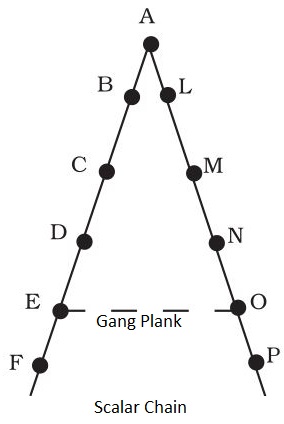
An organisation consists of superiors and subordinates. The formal lines of authority from highest to lowest ranks are known as scalar chain. For example: Let us consider a situation where there is one head ‘A’ who has two lines of authority under her or him. One line consists of B-C- D-E-F. Another line of authority under ‘A’ is L-M-N-O-P. If ‘E’ has to communicate with ‘O’ who is at the same level of authority then she/he has to traverse the route E-D-C-B-A-L-M-N-O. This is due to the principle of scalar chain

However, if there is an emergency then ‘E’ can directly contact ‘O’ through ‘Gang Plank'. This is a shorter route and has been provided so that communication is not delayed.

Scalar Chain and Gang Plank

Long Answer Type

1. Explain the Principles of Scientific management given by Taylor.

Answer

The Principles of Scientific management given by Taylor are:

→ Science not Rule of Thumb: Taylor introduce method of scientific inquiry into the domain of management practice. He believed that there was only one best method to maximise efficiency. This method can be developed through study and analysis. The method so developed should substitute ‘Rule of Thumb’ throughout the organisation. Scientific method involved investigation of traditional methods through work-study, unifying the best practices and developing a standard method, which would be followed throughout the organisation.

→ Harmony, Not Discord: According to the Taylor if manager asked there worker to “get work done” it should not be difficult for them to appreciate their performance. He emphasised that there should be complete harmony between the management and workers. Both should realise that each one is important. Management should share the gains of the company, if any, with the workers. At the same time workers should work hard and willing to embrace for the good of the company.

→ Cooperation, Not Individualism: There should be complete cooperation between the labour and the management instead of individualism. Competition should be replaced by cooperation. Management should not close its ears to any constructive  suggestions made  by  the  employees. They should be rewarded for their suggestions which results in substantial reduction in costs. They should be part of management and, if any important decisions are taken, workers should be taken into confidence. At the same time workers should desist from going on strike and making unreasonable demands on the management. According to the Taylor there should be almost equal division of work and responsibility between worker and management.

→ Development of Each and Every Person to His or Her Greatest Efficiency and Prosperity: To maximize production all possible efforts are made to increase the efficiency of workers. Each person
should be scientifically selected. Then work assigned should suit her or his physical, mental and intellectual capabilities. To increase efficiency, they should be given the required training. Efficient employees would produce more and earn more. This will ensure their greatest efficiency and prosperity for both company and workers.

Page No: 69

2. Explain the following Principles of management given by Fayol with examples:
(a) Unity of direction
(b) Equity
(c) Espirit de corps
(d) Order
(e) Centralisation and decentralisation
(f) Initiative

Answer

(a) Unity of direction: All the units of an organisation should be moving towards the same objectives through coordinated and focused efforts. Each group of activities having the same objective must have one head and one plan. This ensures unity of action and coordination. For example, if a company is manufacturing motorcycles as well as cars then it should have two separate divisions for both of them with their respective heads and plans.

(b) Equity: This principle emphasises kindliness and justice in the behaviour of managers towards workers. This will ensure loyalty and devotion. Each employee is equal in the eyes of the management. There should be no discrimination against anyone on account of sex, religion, language, caste, belief or nationality etc.

(c) Espirit de corps: According to Fayol, Management should promote a team spirit of unity and harmony among employees. Management should promote teamwork especially in large organisations because otherwise objectives would be difficult to achieve. A manager should foster team spirit which will give rise to a spirit of mutual trust and belongingness among team members.

(d) Order: According  to  Fayol, People and materials must be in suitable places at appropriate time for maximum efficiency. If there is a fixed place for everything and it is present there, then there will be no hindrance in the activities of business or factory. This will lead to increased productivity and efficiency.

(e) Centralisation and decentralisation: Centralisation refers the concentration of decision-making authority  is called  centralisation whereas its dispersal among more than one person is known as decentralisation. In Fayol's view there is a need to balance subordinate involvement through decentralisation with managers’ retention of final authority through centralisation. The top management must keep the authority to take important decisions of the organization but adequate authority must be given to the lower level employees to take the department level decisions.

(f) Initiative: Workers should be encouraged to develop and carry out their plans for improvements according to Fayol. Initiative should be encouraged but it does not mean going against the established practices of the company for the sake of being different. A good company should have an employee suggestion system whereby initiative/ suggestions which result in substantial cost or time reduction should be rewarded.

3. Explain the technique of ‘Functional Foremanship’ and the concept of ‘Mental Revolution’ as enunciated by Taylor.

Answer

In the factory system, the foreman represents the managerial figure with whom the workers are in face-to-face contact on a daily basis. Foreman is the lowest ranking manager and the highest ranking worker who is pivot around whom revolves the entire production planning, implementation and control. Thus, Taylor concentrated on improving the performance of this role in the factory set-up. In fact, he identified a list of qualities of a good foreman and found that no single person could fit them all. Thus, he suggested there should be eight persons through which the functions of a foreman should be accomplished. This technique was given the name Functional Foremanship.
According to this, planning and execution functions should be separated. Under the factory manager there would be a planning incharge and a production incharge. Each incharge would have four personnel under him or her.

The following are the four persons that worked under the planning incharge.
• Instruction Card Clerk- To give instructions to the workers.
• Route Clerk- To show the route of production.
• Time and Cost Clerk- To take care about the time and costs.
• Disciplinarian- To ensure that discipline is being maintained.

The following are the four persons that worked under the production incharge.
• Speed Boss- To ensure timely completion of tasks
• Gang Boss- To keep the machines and tools ready for the workers.
• Repair Boss- To ensure proper working of the machines.
• Inspector- To control the quality of work done.

Mental revolution involves a change in the attitude of workers and management towards one another from competition to cooperation. Both should realise that they require one another. Both should aim to increase the size of surplus. This would eliminate the need for any agitation. Management should share a part of surplus with workers. Workers should also contribute their might so that the company makes profits. This attitude will be good for both of them and also for the company.

4. Discuss the following techniques of Scientific Work Study:
(a) Time Study
(b) Motion Study
(c) Fatigue Study
(d) Method Study
(e) Simplification and standardisation of work

Answer

(a) Time Study: It determines the standard time taken to perform a well-defined job. The standard time is fixed for the whole of the task by taking several readings. The method of time study will depend upon volume and frequency of the task, the cycle time of the operation and time measurement costs. The objective of time study is to determine the number of workers to be employed, frame suitable incentive schemes and determine labour costs. For example, if, on the basis of observations it is determined that one person can finish making 1 cardboard box in 20 minutes then, in a working day of 8 hours in a shift and deducting one hour for rest and lunch each worker should make 21 cardboard box.

(b) Motion Study: The study refers to the study of movements like lifting, putting objects, sitting and changing positions etc., which are undertaken while doing a typical job. Unnecessary movements are sought to be eliminated so that it takes less time to complete the job efficiently. For example, Taylor and his associate Frank Gailberth were able to reduce motions in brick layering from 18 to just 5.

(c) Fatigue Study: This study determine the amount and frequency of rest intervals in completing a task. If a worker works continuously physical and mental fatigue sets. The rest intervals will help one to regain stamina and work again with the same capacity. This will result in increased productivity. For example, normally in a plant, work takes place in three shifts of eight hours each.

(d) Method Study: The objective of method study is to find out one best way of doing the job. To determine the best way there are several parameters. Right from procurement of raw materials till the final product is delivered to the customer every activity is part of method study. The objective of the whole exercise is to minimise the cost of production and maximise the quality and satisfaction of the customer. For this purpose many techniques like process charts and operations research etc are used.

(e) Simplification and standardisation of work: Standardisation refers to the process of setting standards for every business activity such as standardisation of process, raw material, time, product, machinery,  methods  or  working conditions. These standards are the benchmarks, which must be adhered to during production. Other techniques by Taylor, such as method study, fatigue study and time study are also based on the concept of standardisation.
Simplification aims at eliminating unnecessary diversity of products. It results in savings of cost of
labour, machines and tools. It implies reduced inventories, fuller utilisation of equipment and increasing turnover.

5. Discuss the differences between the contributions of Taylor and Fayol.

Answer

Basis of DifferenceContributions of Henri FayolContributions of F.W. Taylor
PerspectiveMain concentration on Top level of
management
Main concentration on Shop floor level of a factory
Unity of Command He was Staunch Proponent He did not feel that it is important as under functional foremanship a worker received orders from eight specialists
Applicability Principles are accepted everywhere and are universal in nature. Principles are applicable to specialized situations.
Basis of formation  Theories are based on Personal experienceTheories are based on Observations and experimentation
Focus The main focus was on improving overall
administration
The main focus was on increasing Productivity
PersonalityFayol was a mining engineer or practitioner.Taylor was a mechanical engineer or scientist. 
Expression  General Theory of AdministrationScientific Management

6. Discuss the relevance of Taylor and Fayol's contribution in the contemporary business environment.

Answer

The principles of Taylor and Fayol play an important role in contemporary business environment. Taylor's scientific management principles and Fayol's administrative principles have contributed
immensely to the knowledge of management, which has formed a basis for further practice by managers. Their contributions  are  complementary to each other. Although with the change
of environment in which business is done, the interpretation of these but they prove as important guidelines in complex real business situations. Managers can use them in different situations to solve the recurring problems. Decisions taken on the basis of these principles are based on facts and logic making more appropriate. As they are developed over time by a continuous process of observations and experimentation therefore they provide useful insight into the real business situations. The principles have universal applicability. These principles mainly aim at increasing the efficiency in the organisation along with optimum utilisation of resources. Also, these focus on mutual co-operation between employers and employees while maintaining a harmonious work environment.

Tuesday, 14 July 2015

NCERT Solutions of Class 12th: Ch 1 Nature and Significance of Management

NCERT Solutions of Class 12th: Ch 1 Nature and Significance of Management Business Studies I

Exercises

Page No: 28

Short Answer Type

1. Define management.

Answer

Management is defined as a process of getting things done with the aim of achieving goals effectively and efficiently.

2. Name any two important characteristics of management.

Answer

Two important characteristics of management are:

→ Management is a goal-oriented process: An organisation has a set of basic goals which are the basic reason for its existence. Management unites the efforts of different individuals in the organisation towards achieving these goals.

→ Management is all pervasive: The activities involved in managing an enterprise are common to all
organisations whether economic, social or political. The only difference lies in how it is practiced by different organisations in different regions based on their culture and traditions.

3. Ritu is the manager of the northern division of a large corporate house. At what level does she work in the organisation? What are her basic functions?

Answer

Ritu is working at the middle level of management in the organisation. Her basic functions are:
→ Interpreting the policies formulated by the top management and acting as a link between top level management and operative management.
→ To assign the necessary duties to the persons working in various departments.
 → She has to constantly provide direction and motivation to her employees.
→ She also has to ensure that production is carried out according to plans.

4. Why is management considered a multi-faceted concept?

Answer

Management is considered a multi-faceted concept because it is complex activity that has three main
dimensions.

→ Management of work: All organisations exist for the performance of some work. Management
translates this work in terms of goals to be achieved and assigns the means to achieve it.

→ Management of people: People are an organisation’s greatest asset. Getting work done through people is still a major task for the manager despite all development and technology. It implies dealing with the employees both as an individual and as groups or teams. The task of management is to make people work towards achieving the organisation’s goals, by making their strengths effective and their weaknesses irrelevant.

→ Management of operations: Every organisation has some basic product or service to provide in order to survive. This requires a production process where the inputs are transformed into a product or a service which requires continuous management.

5. Discuss the basic features of management as a profession.

Answer

The basic features of management as a profession are:
→ Management is based on a systematic body of knowledge.
→ There is no restriction on anyone being designated or appointed as manager in any business enterprise.
→ There is no compulsion for managers to be members of an association nor does it have any statutory backing.
→ If an organisation has a good management team that is efficient and effective it automatically serves society by providing good quality products at reasonable prices.

Long Answer Type

1. Management is considered to be both an art and science. Explain.

Answer

Management as art:

→ Art and management both requires the existence of certain theoretical knowledge. Just like art where many literature on dancing, public speaking, acting or music are available, there is a lot of literature available in various areas of management like marketing, finance and human resources which the manager has to specialise in.

→ Art is a very person-alised concept as basic knowledge varies from individual to individual. For example, two dancers will always differ in demonstrating their art. Also in management, a manager applies his scientific methods and body of knowledge to a given situation, an issue or a problem, in his own unique manner depending on how creative they are.

→ Art involves the creative practice of existing theoretical knowledge. All music is based on seven basic notes but a musician unique or different is his use of these notes in a creative manner that is entirely his own interpretation. In management, a manager applies his acquired knowledge in a personalised and skillful manner to different situations as per his own creativity and formulates his
own theories which gives rise to different styles of management.

Management as Science:

→ Science is a systematic body of knowledge. Its principles are based on a cause and effect relationship. Similarly management has its own theory and principles that have developed over a period of time. Also, it has its own vocabulary.

→ Scientific principles are first developed through observation and then tested through repeated
experimentation under controlled conditions over a period of time. Also, principles of management have evolved over a period of  time  based  on  repeated experimentation and observation in different types of organisations. However, since management deals with human beings and human behaviour, the outcomes of these experiments are not capable of being accurately predicted or replicated. Despite this, management fulfills this criterion of science to some extent as the scholars have been able to identify certain theories and principle that act as guidelines in management.

→ Scientific principles have universal validity and application. In management, the theories and principles are valid to some extent but not universal. Their application and use is not universal. They have to be modified according to a given situation.

2. Do you think management has the characteristics of a full fledged profession?

Answer

Management does not meet the exact criteria of a profession. However, it does have some of the features of a profession:

→ Management is based on a systematic body of knowledge comprising well- defined principles based on a variety of business situations. This knowledge can be acquired at different colleges and professional institutes and through a number of books and journals. The subject of management is taught at different institutions For example, Indian Institute of Management (IIM) in India in which entry to different institutes is usually through an examination.

→ The professionals require an educational degree through an examination. However, there is no restriction on anyone being designated or appointed as manager in any business enterprise. But professional knowledge and training is considered to be a desirable qualification, since there is greater demand for those who possess degrees or diplomas from reputed institutions.

→ All professions are affiliated to a professional association which regulates entry, grants certificate of practice and formulates and enforces a code of conduct. In management also, there are several associations of practising managers in India, like the AIMA (All India Management Association) that has laid down a code of conduct to regulate the activities of their members. However, no compulsion for managers to be members of such an association nor does it have any statutory backing.

→ All professions are bound by a code of conduct which guides the behaviour of its members. The basic motive of a profession is to serve the clients by rendering dedicated and committed service. In management also, have a specific Code of Conduct but, it is not obligatory for the managers to abide by them. The basic purpose of management is to help the organisation achieve its stated goal. A good management team that is efficient and effective automatically serves society by providing good quality products at reasonable prices.

3. Coordination is the essence of management. Do you agree? Give reasons.

Answer

Yes, Coordination is the essence of management. It is the force that binds all the other functions of management. It is the common thread that runs through all activities such as purchase, production, sales, and finance to ensure continuity in the working of the organisation. The process of coordinating the activities of an organisation begins at the planning stage itself. Top management plans for the entire organisation. According to these plans the organisational structure is developed and staffed. The functions of directing and controlling must also be coordinated with each other so as to achieve the desired goals. Its importance can be understood by the following reasons:

→ Growth in size: When an organisation grow in size the number of people employed by the organisation also increases where each person differ in their habits of work, background, interests and individual goal also. It may become difficult to integrate their efforts and activities towards the common goals of the organisation. Therefore, for organisational efficiency, it is important to harmonise individual goals and organisational goals through coordination.

→ Functional differentiation: Functions of an organisation are divided into departments, divisions and sections such as finance, production, marketing or human resources. All these departments may have their own objectives, policies and their own style of working. All departments and individuals are interdependent and they have to depend on each other for information to perform their activities. The activity of each department needs to be focused on attainment of common organisational goals. The process of linking the activities of various departments is accomplished by coordination.

→ Specialisation: Modern organisations are characterised by a high degree of specialisation. Organisations, therefore, need to employ a number of specialists which usually think that they only are qualified to evaluate, judge and decide according to their professional criteria. They do not take advice or suggestions from others in matters pertaining to their area of specialisation. This often leads to conflict amongst different specialists as well as othersin the organisation. Therefore, some coordination is required by an independent person to reconcile the differences in approach, interest or opinion of the specialists.

4. ''A successful enterprise has to achieve its goals effectively and efficiently.'' Explain.

Answer

Management has been defined as a process of getting things done with the aim of achieving goals effectively and efficiently.
Being effective or doing work effectively basically means finishing the given task. Effectiveness in management is concerned with doing the right task, completing activities and achieving goals. In other words, it is concerned with the end result.
But it is not enough to just complete the tasks. Completing task efficiently is also important. Efficiency means doing the task correctly and with minimum cost. There is a kind of cost-benefit analysis involved and the relationship between inputs and outputs. If by using less resources more benefits are derived then efficiency has increased. Efficiency is also increased when for the same benefit or outputs, fewer resources are used and less costs are incurred. Management is concerned with the efficient use of the available resources, because they reduce costs and ultimately lead to higher profits.
For management, it is important to be both effective and efficient. Effectiveness and efficiency are two sides of the same coin.
Usually high efficiency is associated with high effectiveness which is the aim of all managers. But undue emphasis on high efficiency without being effective is also not desirable.

5. Management is a series of continuous interrelated functions. Comment.

Answer

The process of management is a series of continuous and interrelated functions to achieve targeted goals. There are various activities that are done by management in given series:

→ Planning: This is the function of determining in advance what is to be done and who is to do it. This implies setting goals in advance and developing a way of achieving them efficiently and effectively. It helps in predicting the situations and choosing the best out of various alternatives to deal with the situation.

→ Organising: This is the management function of assigning duties, grouping tasks, establishing authority and allocating resources required to carry out a specific plan. After a specific plan has been established for the accomplishment of an organisational goal, the organising function examines the activities and resources required to implement the plan. It determines what activities and resources are required, who will do a particular task, where it will be done, and when it will be done. Proper organisation leads to both effectiveness and efficiency in the organisation.

→ Staffing: This means finding the right people for the right job. It make sure that the right people
with the right qualifications are available at the right places and times to accomplish the goals of the organisation. It involves activities such as recruitment, selection, placement and training of personnel.

→ Directing: This involves leading, influencing and motivating employees to perform the tasks assigned to them. Motivation and leadership are two key components of direction.Motivating
workers means simply creating an environment that makes them want to work. Leadership is influencing others to do what the leader wants them to do. A good manager directs through praise and criticism in such a way that it brings out the best in the employee.

→ Controlling: This is the management function of monitoring organisational performance towards the attainment of organisational goals. It involves establishing standards of performance, measuring current performance, comparing this with established standards and taking corrective action where any deviation is found. This helps in finally achieving the goals in time, effectively and efficiently.

Multiple Choice Questions

1. Which is not a function of management of the following
(a) planning
(b) staffing
(c) cooperating
(d) controlling
► (c) cooperating

2. management is
(a) an art
(b) a science
(c) both art and science
(d) neither
► (c) both art and science

3. the following is not an objective of management
(a) earning profits
(b) growth of the organisation
(c) providing employment
(d) policy making
► (d) policy making

4. policy formulation is the function of
(a) top level managers
(b) middle level managers
(c) operational management
(d) all of the above
► (a) top level managers

5. coordination is
(a) function of management
(b) the essence of management
(c) an objective of management
(d) none of the above
► (b) the essence of management