Showing posts with label class6english. Show all posts

Wednesday, 7 October 2015

NCERT Solutions for Class 6th: Ch 10 The Banyan Tree English

NCERT Solutions for Class 6th: Ch 10 The Banyan Tree Honeysuckle English

- Ruskin Bond

Page No: 131

Working with Text

A. Complete the following sentences.

1. The old banyan tree “did not belong” to grandfather, but only to the boy, because ____________.
► the grandfather at sixty-five could no longer climb it.

2. The small gray squirrel became friendly when __________________ .
► he found that the boy did not arm himself with catapult or air-gun.

3. When the boy started to bring him pieces of cake and biscuit, the squirrel ____________________.
► quite bold and was soon taking morsels from the author's hand.

4. In the spring, the banyan tree ___________, and __________ would come there.
► was full of small red figs, birds of all kinds

5. The banyan tree served the boy as a ______________.
► library.

6. The young boy spent his afternoons in the tree _____________.
► when it was not too hot

Page No: 132

B. Answer the following questions.

1. “It was to be a battle of champions.” (8)
(i) What qualities did the two champions have? Pick out words and phrases from the paragraph above this line in the text and write them down.
Mongoose
Cobra
(a) _________________(a) ________________
(b) __________________(b) _________________
(c) __________________(c) __________________
(ii) What did the cobra and the mongoose do, to showtheir readiness for the fight?

Answer

Mongoose
Cobra
(a) superb fighter(a) skilful
(b) clever(b) experienced
(c) aggresive(c) swift

(ii) To show its readiness for the fight, the cobra hissed defiance, his forked tongue darting in and out. It raised three of its six feet off the ground, and spread its broad and spectacled hood. The
mongoose bushed his tail. The long hair on his spine stood up.

2. Who were the other two spectators? What did they do? (Did they watch, or did they join in the fight?) (10)

Answer

The other two spectators were a jungle crow and a myna. They settled on a cactus to watch the outcome. But they did not just watch. They tried to join the fight by hurling themselves at the cobra.

3. Read the descriptions below of what the snake did and what the mongoose did. Arrange their actions in the proper order. (11, 16)

(i) ceased to struggle• grabbed the snake by
the snout
(ii) tried to mesmerise the mongoose• dragged the snake into the bushes
(iii) coiled itself around the mongoose• darted away and bit the cobra on the back
(iv) struck the crow• pretended to attack the cobra on side
(v) struck again and missed• refused to look into the snake's eyes
(vi) struck on the side that the mongoose pretended to attack• sprang aside, jumped in and bit

Answer

Snake
Mongoose
(ii) tried to mesmerise the mongoose• refused to look into the snake's eyes
(vi) struck on the side that the mongoose pretended to attack• pretended to attack the cobra on side
(v) struck again and missed• sprang aside, jumped in and bit
(iv) struck the crow• darted away and bit the cobra on the back
(iii) coiled itself around the mongoose• grabbed the snake by
the snout
(i) ceased to struggle• dragged the snake into the bushes

4. (i) What happened to the crow in the end? (16)
(ii) What did the myna do finally? (17)

Answer

(i) In the end the crow flung nearly twenty feet across the garden by a blow from the cobra's snout. It fluttered about for a while, then lay still.

(ii) Myna finally dropped cautiously to the ground, hopped about, peered into the bushes from a safe distance and then with a shrill cry of congratulations flew away.

Page No: 133

Working with Language

A. 1. The word ‘round’ usually means a kind of shape. What is its meaning in the story?

Answer

The word 'round' in the story means the different phases of the fight between the cobra and the mongoose.

2. Find five words in the following paragraph, which are generally associated with trees. But here, they have been used differently. Underline the words.

Hari leaves for work at nine every morning. He works in the local branch of the firm of which his uncle is the owner. Hari’s success is really the fruit of his own labour. He is happy, but he has a small problem. The root cause of his problem is a stray dog near his office. The dog welcomes Hari with a loud bark every day.

Answer

Leaves, branch, fruit, root and bark.

Page No: 134

B. The words in the box are all words that describe movement. Use them to fill in the blanks in the sentences below.

dived  gliding  sprang  darting
whipped... back  delving

1. When he began to trust me, the squirrel began  ————— into my pockets for morsels of cake.
► delving

2. I saw a cobra  ————— out of a clump of cactus.
► gliding

3. The snake hissed, his forked tongue  ————— in and out.
► darting

4. When the cobra tried to bite it, the mongoose  ——————— aside.
► sprang

5. The snake  —————— his head  —————— to strike at the crow.
► whipped, back

6. The birds  —————— at the snake.
► dived

C. Find words in the story, which show things striking violently against each other.

1. The cobra struck the crow, his snout th  — — — ing against its body. (15)
► thudding

2. The crow and the myna c  — ll  — — — — in mid-air. (13)
► collided

3. The birds dived at the snake, but b  — — — — d into each other instead. (14)
► bumped

Page No: 135

C. Choose would and could to replace the italicised words in the following sentences.
Grandfather says, in the old days,

1. elephants were able to fly in the sky, like clouds. They were also able to change their shapes. They used to fly behind clouds and frighten them. People used to look up at the sky in wonder.
► elephants could fly in the sky like clouds. They could change their shapes. They would fly behind clouds and frighten them. People would look up at the sky and wonder.

2. because there was no electricity, he used to get up with the sun, and he used to go to bed with the sun, like the birds.
► because there was no electricity, he would get up with the sun, and he would go to bed with the sun, like the birds.

3. like the owl, he was able to see quite well in the dark. He was able to tell who was coming by listening to their footsteps.
► like the owl, he could see quite well in the dark. He could tell who was coming by listening to their footsteps.

Go To Chapters

Tuesday, 6 October 2015

NCERT Solutions for Class 6th: Ch 9 Desert Animals English

NCERT Solutions for Class 6th: Ch 9 Desert Animals Honeysuckle English

Page No: 117

Working with Text

A. 1. Talk to your partner and say whether the following statements are true or false.

(i) No animal can survive without water.
► True

(ii) Deserts are endless sand dunes.
► False

(iii) Most snakes are harmless.
► True

(iv) Snakes cannot hear, but they can feel vibrations through the ground.
► True

(v) Camels store water in their humps.
► False

2. Answer the following questions.

(i) How do desert animals survive without water? (1)

Answer

Desert animals cannot survive without water. They find different ways of coping with the harsh desert conditions. For example, gerbils spend the hottest part of the day in cool underground burrows. And darkling beetles catch moisture on their legs and then lift them into the air till the drops trickle down into their mouths.

(ii) How do mongooses kill snakes? (6)

Answer

Mongooses kill snakes without getting hurt themselves. Their reactions are so fast that they dodge each time the snake strikes. They continually make a nuisance of themselves, and after a while, when the snake gets tired, they quickly dive in for the kill.

(iii) How does the hump of the camels help them to survive when there is no water? (9)

Answer

The humps of the camels help the animal to survive in the desert, by acting as storage containers. The hump is full of fat that nourishes the camel when food is scarce. If they have nothing to eat for
several days, their humps shrink as the fat is used up.

B. Read the words/phrases in the box. With your partner find their meaning in the dictionary.

Harsh conditions  harmless  survive  intruder  threatened  predators  prey  continually 
Fill in the blanks in the following passage with the above words/phrases.

All animals in forests and deserts struggle to ______ in ______. Though most of the animals are ______, some are dangerous when ______. If an ______ is noticed, they attack or bite to save themselves. They struggle ______ for food and water. Some animals are called ______ because they ______ on other animals.

Answer

All animals in forests and deserts struggle to survive in harsh conditions. Though most of the animals are harmless, some are dangerous when threatened. If an intruder is noticed, they attack or bite to save themselves. They struggle continually for food and water. Some animals are called predators because they prey on other animals.

Page No: 118

Thinking about Language

Look at these sentences.
• Most snakes are quite harmless, but a few are poisonous.
• Most snakes lay eggs, but the rattlesnake gives birth to its young.

Now write five sentences like these using 'most' and the clues below.

1. (90% of) people are honest (10%) are dishonest.

__________________________________________________
► Most people are honest, but about ten percent are dishonest.

2. (Lots of) fruit have plenty of sugar, (some) citrus fruit are low in sugar.
__________________________________________________
► Most fruits have plenty of sugar, but some citrus fruits have less sugar.

3. (Every soft drink except this one) has lots of 'empty calories'.
__________________________________________________
► Most soft drinks have lots of 'empty calories', but this one does not have 'empty calories'.

4. (The majority of) films are romances, (a few) are on other topics.
__________________________________________________
► Most films are romances, but a few are on other topics.

5. (A majority of) people agree that he is a good leader, (just a few) disagree.
__________________________________________________
► Most people agree that he is a good leader, but a few disagree.

Page No: 119

Look at these sentences.
• Animals cannot survive for long without water.
• So desert animals have to find different ways of coping.

The first sentence says what cannot happen or be done; the second tells us what must, therefore, be done, what it is necessary to do.

Complete these sentences using cannot and have to/has to.

1. You ______ reach the island by land or air; you ______ go by boat.
► You cannot reach the island by land or air; you have to go by boat.

2. We ______ see bacteria with our eyes; we ______ look at them through a microscope.
► We cannot see bacteria with our eyes; we have to look at them through a microscope.

3. He ______ have a new bicycle now; he ______ wait till next year.
► He cannot have a new bicycle now; he has to wait till next year.

4. Old people often ______ hear very well; they ______ use a hearing aid.
► Old people often cannot hear very well; they have to use a hearing aid.

5. Road users ______ do what they wish; they ______ follow the traffic rules.
► Road users cannot do what they wish; they have to follow the traffic rules.

6. She ______ accept this decision; she ______ question it.
► She cannot accept this decision; she has to question it.

7. You ______ believe everything you hear; you ______ use your own judgement.
► You cannot believe everything you hear; you have to use your own judgment.

Whatif

Shel Silverstein

1. (i) Who is the speaker in the poem?

Answer

The speaker in the poem is child.

(ii) With your partner list out the happenings the speaker is worried about.

Answer

The speaker is worried if he was dumb in school, if they had closed the swimming pool, if he got beaten up, if there was poison in his cup, if he started to cry, if he got sick and died, if he flunked that test, if green hair grew on his chest, if nobody liked him, if a bolt of lightning struck him, if he did not grow taller, if his head started getting smaller, if the fish would not bite, if the wind tore up his kite, if they started a war, if his parents got divorced, if the bus was late, if his teeth did not grow in straight, if he tore his pants, if he never learnt to dance.

(iii) Why do you think she/he has these worries? Can you think of ways to get rid of such worries?

Answer

She/he has these worries because in the night she/he is free therefore, these fearful thoughts started coming in his mind. To get rid of such worries she/he should involve their mind in creative work.

2. Read the following line. 
Some Whatifs crawled inside my ear
Can words crawl into your ear? This is an image. The poet is trying to make an image of what she/he experiences. Now with your partner try and list out some more images from the poem.

Answer

Some other images are:
• Pranced and partied all night long
• Sang their old whatif song.
• Whatif a bolt of lightning strikes me

Saturday, 3 October 2015

NCERT Solutions for Class 6th: Ch 8 A Game of Chance English

NCERT Solutions for Class 6th: Ch 8 A Game of Chance Honeysuckle English

Page No: 103

Working with Text

A. Complete the following sentences from memory choosing a phrase from those given in brackets.

1. ————————————— was held at the time of the Eid festival. (A big show, A big fair, A big competition)
► A big fair

2. Tradesmen came to the village with all kinds of goods —————— . (to display, to buy, to sell)
► to sell

3. Uncle told me  —————— while he was away. (not to buy anything, not to go anywhere, not to talk to anyone)
► not to buy anything

4. The owner of the Lucky Shop wanted everybody present ——————— . (to play the game, to win a prize, to try their luck)
► to try their luck

5. The first time I took a chance I got  —————————————–— . (a bottle of ink, two pencils, a trifle)
► two pencils

6. Uncle told me that the shopkeeper had made ————————. (a fool of me, a good profit, friends with many people)
► a fool of me

Page no: 104

B. Answer the following questions.

1. Why do you think Rasheed’s uncle asked him not to buy anything in his absence? (3)

Answer

Rasheed’s uncle asked him not to buy anything in his absence because he knew that the shopkeepers would cheat him.

2. Why was the shop called ‘Lucky Shop’? (4)

Answer

The shop was called Lucky Shop because everybody can try their luck.

3. An old man won a clock and sold it back to the shopkeeper. How much money did he make? (5)

Answer

The old man made 15 rupees by selling the clock back to the shopkeeper.

4. How many prizes did the boy win? What were they? (6)

Answer

The boy won four prizes. They were a comb, a fountain pen, a wristwatch and a table lamp.

5. Why was Rasheed upset? (7, 8, 9)

Answer

Rasheed was upset because he had hopes of winning a big prize and he continued trying his luck again and again. But every time he got a trifle. People were looking at him and laughing at his bad luck, but no one showed any sympathy. He played till he finished all his money.

6. In what way did the shopkeeper make a fool of Rasheed? (11)

Answer

The shopkeeper played tricks to tempt to try his luck by making him believe that it was luck that got the old man and the boy their prizes but in reality they were friends of the shopkeeper. Therefore, Rasheed tried his luck again and again but only got some cheap things which he sold back to the shopkeeper and lost all his money.

Working with Language

I. The words given against the sentences below can be used both as nouns and verbs. Use them appropriately to fill in the blanks.

1. (i) The two teams have  ————— three matches already. (play)
► played

(ii) The last day’s  ———— was excellent.
► play

2. (i) She has a lovely  ————— . (face)
► face

(ii) India  ————— a number of problems these days.
► is facing

3. (i) He made his  —————— in essay-writing.(mark)
► mark

(ii) Articles  ————— ‘sold’ are reserved.
► marked

4. (i) The police are  ————— the area to catch the burglars. (comb)
► combing

(ii) An ordinary plastic ————— costs five rupees.
► comb

5. (i) He gave a  ————— in answer to my question. (smile)
► smile

(ii) We also  ————— to see him smile.
► smiled

6. (i) He said he  ————— to be invited to the party. (hope)
► hoped

(ii) We gave up  —————— of his joining the party.
► hope

7. (i) The boys put up a good athletic ————— . (show)
► show

(ii) The soldiers  ————— great courage in saving people from floods.
► showed

8. (i) You deserve a  ————— on the back for your good performance. (pat)
► pat

(ii) The teacher  ———— the child on the cheek to encourage her.
► patted

Page No: 105

B. Notice the use of 'there' in the following sentences.
There was a big crowd at the fair.
There were many things I'd have liked to buy.
Now rewrite the following sentences using 'there' in the beginning. Look at the following examples.
I can do nothing to help you.
There is nothing I can do to help you.
A man at the door is asking to see you.
There is a man at the door asking to see you.

1. This park has beautiful roses.
► There are beautiful roses in this park.

2. Your story has no fun in it.
► There is no fun in your story.

3. We have no secrets between us.
► There are no secrets between us.

4. My village has two primary schools.
► There are two primary schools in my village.

5. This problem can be solved in two ways.
► There are two ways to solve this problem.

Page No: 106

C. Fill in the blanks in the paragraph below with words from the box.

huge big foolish interesting tiny unlucky last

There was a  ———— Eid fair in our village. We could buy anything from a  ————— toy to a
———— camel. I went to the fair on its ———— day with Uncle and Bhaiya. We went to the Lucky Shop. It was very ———— . I tried my luck but did not win any prize. Later, Uncle told me that I was more  ———— than  ———— .

Answer

There was a big Eid fair in our village. We could buy anything from a tiny toy to a huge camel. I went to the fair on its last day with Uncle and Bhaiya. We went to the lucky shop. It was very interesting. I tried my luck but did not win any prize. Later uncle told me that I was more foolish than unlucky.

Thursday, 1 October 2015

NCERT Solutions for Class 6th: Ch 7 Fair Play English

NCERT Solutions for Class 6th: Ch 7 Fair Play Honeysuckle English

Premchand

Page No: 91

Working with Text

A. Match the sentences under I with those under II.
I
1. Jumman and Algu were the best of friends.
2. Jumman’s aunt transferred her property to him.
3. The aunt decided to appeal to the panchayat.
4. Algu was unwilling to support the aunt.
5. Jumman was very happy to hear Algu’s name as head Panch.
II
1. He believed that his friend would never go against him.
2. She wanted justice.
3. In the absence of one, the other took care of his family.
4. The condition was that he would be responsible for her welfare.
5. The bond of friendship between him and Jumman was very strong.

Answer

Part I
Part II
1. Jumman and Algu were the best of friends.3. In the absence of one, the other took care of his family.
2. Jumman’s aunt transferred her property to him.4. The condition was that he would be responsible for her welfare.
3. The aunt decided to appeal to the panchayat.2. She wanted justice.
4. Algu was unwilling to support the aunt.5. The bond of friendship between him and Jumman was very strong.
5. Jumman was very happy to hear Algu’s name as head Panch.1. He believed that his friend would never go against him.

B. Who says this to whom and why?

1. “My wife knows best how to run the house.”
► Jumman said this to his aunt because he was shameless and had grown tired of her. she had asked him for a monthly allowance to set up a separate kitchen, but he didn't want to give her money.

2. “But is it right, my son, to keep mum and not say what you consider just and fair?”
► Jumman's aunt said this to Algu because she had gone to Algu for help, but Algu had politely refused her plea as he could not go against his firend, Jumman.

3. “What have you to say in your defence?”
►Algu said this to Jumman because he was made the head Panch by the aunt so he asked Jumman to say in his defence regarding his mistreatment of the aunt.

4. “I can’t pay you a penny for the wretched beast you sold me.”
►Samjhu Sahu said this to Algu because Algu demanded payment for the bullock he had sold to Samjhu.

5. “Victory to the panchayat. This is justice.”
► Algu said this over and over again in front of the village because he was happy that Jumman had not deviated from the path of justice in spite of the enmity between them.

C. Answer the following questions.

1. “Then the situation changed.” What is being referred to? (2)

Answer

The situation being referred to is Jumman and his family’s behaviour towards his aunt. Jumman's aunt had transferred her property to him on the understanding that he would look after her. The arrangement worked well for a couple of years but after a couple of years, Jumman and his family grew tired of her. He became as indifferent to her and his wife too grudged even the little food that the old lady wanted everyday.

2. When Jumman’s aunt realised that she was not welcome in his house, what arrangement did she suggest? (3)

Answer

When Jumman's aunt realised that she was not welcome in his house she suggested that Jumman should give her a monthly allowance so that she could set up a separate kitchen.

Page No: 92

3. What was the villagers’ reaction when the aunt explained her case to them? (4)

Answer

When the aunt explained her case to the villagers, some sympathised with her, others laughed at her and a few others advised her to make it up with her nephew and his wife.

4. Why was Jumman happy over Algu’s nomination as head Panch? (6)

Answer

Jumman was happy over Algu's nomination as head Panch because Algu was his best friend so he would never go against him.

5. “God lives in the heart of the Panch.” the aunt said. What did she mean? (6)

Answer

She meant that a Panch was always unbiased and would not kill his conscience for the sake of friendship. Everybody is equal before him. The justice delivered was the justice delivered by God.

6. What was Algu’s verdict as head Panch? How did Jumman take it? (7, 8)

Answer

Algu's verdict as head Panch was that Jumman had to pay his aunt a monthly allowance, or else the property would go back to her. Jumman felt betrayed and became Algu's enemy.

7. Algu found himself in a tight spot. What was his problem? (9)

Answer

One of Algu's fine pair of bullocks died, and he sold the other to Samjhu Sahu on the understanding that Sahu would pay the price of the bullock in a month's time. The bullock died within a month and Sahu refused to pay Algu.

8. Why was Algu upset over Jumman’s nomination as head Panch? (12, 13)

Answer

Algu was upset because he was his friend no more after Algu had given a verdict in favour of Jumman's aunt. Jumman was Algu's enemy and wanted revenge.

9. What was Jumman’s verdict as head Panch? How did Algu take it? (14, 15)

Answer

Jumman's verdict as head Panch was that that since the bullock did not suffer from any disability or disease when Sahu bought it, although the death was unfortunate Algu could not be blamed for it. Therefore, Sahu would have to pay Algu the price of the bullock. Algu could not contain his feelings on the verdict. He stood up and said loudly over and over again, "Victory to the panchayat. This is justice. God lives in the heart of the Panch."

10. Which of the following sums up the story best?
(i) “I also know that you will not kill your conscience for the sake of friendship.”
(ii) “Let no one deviate from the path of justice and truth for friendship or enmity.”
(iii) “The voice of the Panch is the voice of God.”
Give a reason for your choice. 

Answer

(ii) “Let no one deviate from the path of justice and truth for friendship or enmity.”
This sentence sums up the story best because boht Algu and Jumman gave verdict without keeping any friendship nor enimity.

Working with Language

A. Replace the italicised portion of each sentence below with a suitable phrase from the box. Make necessary changes, wherever required.

look after swallow make it up keep mum
go into ease one’s conscience as ill luck would have it
a tight spot take chances my heart sank

1. The best way to avoid an unnecessary argument is to remain silent.
► The best way to avoid an argument is to keep mum.

2. Unfortunately, the train I was trying to catch was cancelled.
► As ill luck would have it, the train I was trying to catch was cancelled.

3. He has been told not to take risks while driving a car through a crowded street.
► He has been told not to take chances while driving a car through a crowded street.

4. The patient needs to be properly taken care of.
► The patient needs to be properly looked after.

5. Why don't the two of you end your quarrel by shaking hands?
► Why don't the two of you make it up by shaking hands?

6. I was in a difficult situation till my friends came to my rescue.
► I was in a tight spot till my friends came to my rescue.

7. When I saw a pile of dirty dishes, I felt very disappointed.
► When I saw a pile of dirty dishes, my heart sank.

8. I will examine the matter carefully before commenting on it.
► I will go into the matter carefully before commenting on it.

9. They criticised him in the meeting but he accepted without protest all the criticism.
► They criticised him in the meeting but he swallowed all the criticism.

10. It will free me from worry to know that I had done nothing wrong.
► It will ease my conscience to know that I had done nothing wrong.

B. Look at the following phrases and their meanings. Use the phrases to fill in the blanks in the sentences given below.

set up
put in place or start
set aside
save or keep for a particular purpose
set down
write or record
set out
start on a journey
set in
begin and seem likely to continue

1. Why don’t you ————— your ideas on paper?
► set down

2. A fund has been ————— for the soldiers’ families.
► set up

3. We should ————— a little money every month.
► set aside

4. You should buy some woollens before winter ———— .
► set in

5. They ————— on the last stage of their journey.
► set out

Go To Chapters

Monday, 28 September 2015

NCERT Solutions for Class 6th: Ch 6 Who I Am English

NCERT Solutions for Class 6th: Ch 6 Who I Am and The Wonderful words (Poem) Honeysuckle English

Part I

Page No: 73

Working with Text

A. Answer the following questions.

1. Peter’s favourite day of the week is Sunday because ————————————————
► on this day his whole family always goes to the cinema hall to see a film.

2. Nasir wants to learn  ———————————————————
► how to preserve seeds so that they can be used again without investing money on them.

3. Dolma believes that she can make a good Prime Minister because  ———————————
————————————
► she wants to make things better for everyone.

B. Write True or False against each of the following statements.

1. Peter is an only child.  ——————————
► False

2. When Serbjit gets angry he shouts at people.  ——————————
► False

3. Nasir lives in the city.  ——————————
► False

4. Radha’s mother enjoys doing things with her.  ——————————
► True

Part II

Page No: 76

Working with Text

Fill in the blanks to name the different kinds of intelligence. One has been done for you.

When I enjoy listening to people and solving their problems I use my interpersonal intelligence.

(i) When I enjoy dancing or physical activity, I use my ______________ intelligence.
► bodily

(ii) When I enjoy looking at maps and examining pictures, I use my ___________intelligence.
► visual

(iii) When I enjoy working with numbers and solving maths problems, I use my ___________ intelligence.
► mathematical

(iv) When I enjoy telling a story or arguing, I use my ____________ intelligence.
► verbal

Match the job on the left with its description on the right.

(i) Navigator - (a) Advises people what to do about jobs, personal problems, etc.
(ii) Architect - (b) Works in politics, usually by standing for election.
(iii) Politician - (c) Finds and monitors the route to get to a place, or the direction of travel.
(iv) Engineer - (d) Reports on recent news for newspaper, radio, or TV.
(v) Computer programmer -  (e) Plans the design of a building, town, or city.
(vi) Athlete - (f) Controls and puts together a programme of music.
(vii) Disc jockey - (g) Works in sports or activities such as running, jumping etc.
(viii) Composer - (h) Designs and builds things like roads, bridges, or engines.
(ix) Counsellor - (i) Makes up notes to create music.
(x) Journalist - (j) Designs the system by which a computer runs or gives information.

Answer

(i) Navigator - (c) Finds and monitors the route to get to a place, or the direction of travel.
(ii) Architect - (e) Plans the design of a building, town, or city.
(iii) Politician - (b) Works in politics, usually by standing for election.
(iv) Engineer - (h) Designs and builds things like roads, bridges, or engines.
(v) Computer Programmer - (j) Designs the system by which a computer runs or gives information.
(vi) Athlete - (g) Works in sports or activities such as running, jumping etc.
(vii) Disc jockey - (f) Controls and puts together a programme of music.
(viii) Composer - (i) Makes up notes to create music.
(ix) Counsellor - (a) Advises people what to do about jobs, personal problems, etc.
(x) Journalist - (d) Reports on recent news for newspaper, radio, or TV.

The Wonderful Words

- Mary O'Neil

Page No: 83

Working with Poem

1. With your partner, complete the following sentences in your own words using the ideas in the poem.

(i) Do not let a thought shrivel and die because  ————————————
► for want of a way to say it

(ii) English is a  ————————— with words that everyone can play.
► wonderful game

(iii) One has to match  ——————————————
► to the brightest thoughts in your head

(iv) Words are the  ——————————— of thought.
► food and dress 

2. In groups of four discuss the following lines and their meanings.

(i) All that you do is match the words
To the brightest thoughts in your head

►The poet says that you only have to select words to express your thoughts present in your head

(ii) For many of the loveliest things
Have never yet been said

► The poet encourage readers to convert their thoughts into words and speak them as these are loveliest things that never yet been said.

(iii) And everyone’s longing today to hear
Some fresh and beautiful thing

► All the people are listening to the same thoughts. Everyone is excited to hear some new thing so speak your thoughts brilliantly.

(iv) But only words can free a thought
From its prison behind your eyes

► You have thoughts in your mind but its in prison behind your eyes. You need to free thoughts by giving them words.

Friday, 25 September 2015

NCERT Solutions for Class 6th: Ch 5 A Different kind of school English

NCERT Solutions for Class 6th: Ch 5 A Different kind of school and Where do all the teachers go? (Poem) Honeysuckle English

- E.V. Lucas

Page No: 62

Working with Text

A. Put these sentences from the story in the right order and write them out in a paragraph. Don’t refer to the text.
• I shall be so glad when today is over.
• Having a leg tied up and hopping about on a crutch is almost fun, I guess.
• I don’t think I’ll mind being deaf for a day — at least not much.
• But being blind is so frightening.
• Only you must tell me about things.
• Let’s go for a little walk.
• The other bad days can’t be half as bad as this.

Answer

Let's go for a little walk. Only you must tell me about things. I shall be so glad when today is over. The other bad days can't be half as bad as this. Having a leg tied up and hopping about on a crutch is almost fun, I guess. I don't think I'll mind being deaf for a day - at least not much. But being blind is so frightening.

B. Answer the following questions

1. Why do you think the writer visited Miss Beam’s school? (1)

Answer

The writer visited Miss Beam’s school because he had heard a great deal about the school.

Page No: 63

2. What was the ‘game’ that every child in the school had to play? (9)

Answer

The 'game' that every child in the school had to play was that each term every child had one blind day, one lame day, one deaf day, one injured day and one dumb day.

3.  “Each term every child has one blind day, one lame day…” Complete the line. Which day was the hardest? Why was it the hardest? (9, 11, 15)

Answer

"Each term every child has one blind day, one lame day, one deaf day, one injured day and one dumb day." The dumb day was the hardest because the children's mouths could not be bandaged, so they really had to exercise their will power to remain silent.

4. What was the purpose of these special days? (5, 9)

Answer

The purpose of these special days was to teach the children thoughtfulness - kindness to others, and how to be responsible citizens. These days make the children appreciate and understand misfortune by making them share in the misfortune of others.

Working with language

A. Match the words and phrases with their meanings in the box below.
                               paragraph numbers
1. homesick                        (3)
2. practically                      (4)
3. it pains me                     (7)
4. appreciate                      (9)
5. thoughtless                   (10)
6. exercise                        (11)
7. relief                            (13)
8. ghastly                         (14)

Almost, it hurts me, terrible, test the strength of, understanding the difficulties, wanting to be home, a welcome change, not very caring

Answer

1. homesick - wanting to be home
2. practically - Almost
3. it pains me - it hurts me
4. appreciate - understanding the difficulties
5. thoughtless - not very caring
6. exercise - test the strength of
7. relief - a welcome change
8. ghastly - terrible

B. Re-word these lines from the story:
1. I had heard a great deal about Miss Beam’s school.
2. Miss Beam was all that I had expected — middle-aged, full of authority.
3. I went to the window which overlooked a large garden.
4. “We cannot bandage the children’s mouths, so they really have to exercise their will-power.”

Answer

1. I had come to know a lot about the school run by Miss Beam.
2. Miss Beam was middle-aged authoritative as I had thought her to be.
3. I walked towards a window from which one could see a garden of a large size.
4. "It is not possible to put bandages on children’s mouths so an exercise of will power is required on their part."

C. Given below is a page from a dictionary. Look at it carefully and

i) find a word which means the same as ghastly. Write down the word and its two meanings.
► Terrible is that word. Its two meanings are: causing fear and very bad.

ii) find a word meaning a part of the school year.
► a term

iii) find a word that means examination.
► test

Where do all the teachers go

Peter Dixon

Page No: 68

Working with Poem

1. Answer these questions.

(i) Why does the poet want to know where the teachers go at four o’clock?

Answer

The poet wanted to know where the teachers go at four o’clock because this is time when school got over.

(ii) What are the things normal people do that the poet talks about?

Answer

The things normal people do that the poet talked about are living in houses, washing socks, wearing pyjamas, watching TV, picking their noses, living with their parents, not spelling right, being bad, making mistakes, getting punished, losing books, scribbling on desk tops, wearing old dirty jeans.

(iii) What does he imagine about

(a) where teachers live?
► In houses

(b) what they do at home?
► washed their socks, wore pyjamas, picked their noses, and watched TV.

(c) the people with whom they live?
► lived with other people and if they also had mothers and fathers.

(d) their activities when they were children in school?
► they were also bad, made mistakes, never spelled right, and were punished in the corner for pinching the chocolate flakes. They ever lost their hymn books, scribbled on the desk tops, or wore old dirty jeans.

(iv) Why does the poet wonder if teachers also do things that other people do?

Answer

The poet wondered if teachers also do things that other people do because he had seen them as super humans. They are strict, did not make any mistakes and punish those who did.

(v) How does the poet plan to find out? What will he do once he finds out?

Answer

The poet plans to follow one of the teachers on the way back home that day to find out what they did. Once he succeeds in doing do, he would compose it into a poem, which then those teachers would read to their students.

2. What do you think these phrases from the poem mean?

(i) punished in the corner
► getting punishment of standing in the corner of the classroom

(ii) leave their greens
► Leaving the playground after the bell strikes for the next class to begin
Go To Chapters

Wednesday, 23 September 2015

NCERT Solutions for Class 6th: Ch 4 An Indian-American Women in Space: Kalpana Chawla English

NCERT Solutions for Class 6th: Ch 4 An Indian-American Women in Space: Kalpana Chawla and Beauty (Poem) Honeysuckle English

Page No: 50

Working with Text

A. Answer the following questions.

1. Where was Kalpana Chawla born? Why is she called an Indian – American? (3)

Answer

Kalpana Chawla was born in Karnal, Haryana. She was called an Indian-American because she went to US and became its naturalised citizen.

2. When and why did she go to the U.S.? Who did she marry? (2, 3)

Answer

She went to US after completing a Bachelor of Science degree in aeronautical engineering for pursuing master’s degree. She married flight instructor Jean-Pierre Harrison.

3. How did she become an astronaut? What gave her the idea that she could be an astronaut? (3)

Answer

After qualifying as a pilot, Chawla applied to NASA space shuttle program. She was first hired as a research Scientist at NASA. In 1994 she was selected at NASA for training as an astronaut. It was her success as a pilot which gave her the idea that she could become an astronaut.

4. What abilities must an astronaut have, according to the journalist? (6)

Answer

According to the journalist, it takes enormous ability to be an astronaut. An astronaut must know a lot about everything, from biology to astrophysics to aeronautical engineering. In this age of super-specialisation, you must have encyclopedic knowledge to be an astronaut.

5. Describe Kalpana Chawla’s first mission in space. (5)

Answer

Kalpana Chawla’s first mission was in the space shuttle Columbia. It was a 15 days, 16 hours and 34 minutes. During this time, she went around the earth 252 times travelling 1.45 million km. The crew performed experiments such as pollinating plants to observe food growth in space. It also made test for making stronger metals and faster computer chips. It was all done for a price tag of 56 million dollars.

6. What does Kalpana Chawla say about pursuing a dream? Do you agree with her that success is possible? (7)

Answer

Kalpana Chawla said that the path from dreams to success does exist. One needs to have the vision to find it, and the courage to get onto it. Yes, success is possible.

Page No: 51

B. Read the newspaper report to find the following facts about the Columbia’s ill-fated voyage.

l. Date and place of lift off:  ————————————————————
► 16th January, 2003; Kennedy Space Center, Florida

2. Number of astronauts on board:  ———————————————––
► 7 (Seven)

3. Number of days it stayed in space:  ——————————————––
► 16 Days

4. Number of experiments done by scientists:  —————————––
► 80 experiments

5. Date of return journey:  ———————————————–————–––
► Sunday, 1st February, 2003

6. Height at which it lost contact:  ————————————————––
► 200,000 feet

Working with Language

A. Match the Following:

1. unprecedented space tragedy
  • something that causes feelings of respect and wonder
2. certified flight instructor
  • having knowledge of a wide variety of subjects
3. space mission
  • nowadays, in these times
4. super specialisation
  • a set of jobs to be done in space by a group
5. encyclopaedic knowledge
  • a person with the correct qualification to teach people to fly planes
6. awe-inspiring
  • a sad accident of a kind that has never happened before in space
7. in this age
  • great expertise in a limited field or a particular subject

Answer

1. unprecedented space tragedy
  • a sad accident of a kind that has never happened before in space
2. certified flight instructor
  • a person with the correct qualification to teach people to fly planes
3. space mission
  • a set of jobs to be done in space by a group
4. super specialisation
  • great expertise in a limited field or a particular subject
5. encyclopaedic knowledge
  • having knowledge of a wide variety of subjects
6. awe-inspiring
  • something that causes feelings of respect and wonder
7. in this age
  • nowadays, in these times

Page No: 52

B. Use these phrases in sentences of your own, after finding out their meanings.

1. broke apart
► break violently - The laptop broke apart when it slipped from the hands.

2. streaked over
► went over it quickly: A meteor streaked over cloud in the night.

3. spread across
► Distributed over a given area: Pollution is spread across the worls.

4. lifted off
► Start flying: Pilot finally lifted off the aeroplane.

5. blast off
► Take off: The rocket blasted off yesterday.

6. went on
► To continue: He went on reciting his poems.

7. cheered along
► Encourage: Audience cheered along for their favourite participant.

8. on board
► Participation: Children were on board for the picnic.

9. carry on
► Continue: Scientists carried on their research work.

C. We add ‘un-’ to make opposites.
For example, true — untrue.
Add ‘un’– to the words below to make their opposites. Then look up the meanings of the words you have formed in the dictionary.

l. identified  —————
► Unidentified

2. controlled  —————
► Uncontrolled

3. attended  ——————
► Unattended

4. successful  —————
► Unsuccessful

5. important  —————
► Unimportant

6. educated  ——————
► Uneducated

7. interesting  —————
► Uninteresting

8. qualified  ——————
► Unqualified

9. trained  ——————–
► Untrained

10. answerable  ———–—
► Unanswerable

Writing

Given below are some words that are spelt differently in British and American English. Fill in the blanks accordingly.

BritishAmerican
1. colour
2. labor
3. traveler
4. counsellor
5. centre
6. theater
7. organize
8. realise
9. defense
10. offence


Answer

BritishAmerican
1. colourcolor
2. labourlabor
3. travellertraveler
4. counsellorcounselor
5. centrecenter
6. theatretheater
7. organiseorganize
8. realiserealize
9. defencedefense
10. offenceoffense

Beauty

E-yeh-shure

Page No: 55

Working with Poem

1. The poet says, “Beauty is heard in …”
Can you hear beauty? Add a sound that you think is beautiful to the sounds the poet thinks are beautiful.
The poet, Shelley, said:
Heard melodies are sweet,
But those unheard are sweeter.
What do you think this means? Have you ever ‘heard’ a song in your head, long after the song was sung or played?

Answer

The chirping of birds is also beautiful.
The poet says that when we hear melodies, we find it sweet but after hearing those melodies when we imagine about melodies i.e., unheard melodies we found it more sweeter than the original melody itself.
Yes, sometimes I heard long after the song was sung or played.

2. Read the first and second stanzas of the poem again. Note the following phrases.
corn growing, people working or dancing, wind sighing,
rain falling, a singer chanting
These could be written as
• corn that is growing
• people who are working or dancing
Can you rewrite the other phrases like this? Why do you think the poet uses the shorter phrases?

Answer

wind that is sighing
rain that is falling
a singer who is chanting
The poet uses the shorter phrases to enhance its beauty.

Tuesday, 22 September 2015

NCERT Solutions for Class 6th: Ch 3 Taro's reward English

NCERT Solutions for Class 6th: Ch 3 Taro's reward and The Quarrel (Poem) Honeysuckle English

Page No: 34

Working with Text

A. Answer the following questions.

1. Why did Taro run in the direction of the stream? (5)

Answer

Taro run in the direction of the stream because earlier he had never heard or seen a rushing stream in the forest also he was thirsty.

2. How did Taro’s father show his happiness after drinking saké? (7)

Answer

After drinking saké, Taro’s father show his happiness by doing a little dance in the middle of the floor.

3. Why did the waterfall give Taro saké and others water? (12)

Answer

The waterfall give Taro saké and others water because he was a thoughtful son who honoured and obeyed his parents always and worked very hard to give them everything they needed while others were greedy.

4. Why did the villagers want to drown Taro? (10,11)

Answer

The villagers want to drown Taro because they thought that he had tricked them by telling that stream gives saké.

5. Why did the Emperor reward Taro? (13)

Answer

The emperor rewarded Taro for as he honoured and obeyed his parents. This was done to encourage all the children to honor and obey their parents.

B. Mark the right item.

1. Taro earned very little money because
(i) he didn’t work hard enough.
(ii) the villagers didn’t need wood.
(iii) the price of wood was very low.
► (iii) the price of wood was very low.

2. Taro decided to earn extra money
(i) to live a more comfortable life.
(ii) to buy his old father some saké.
(iii) to repair the cracks in the hut.
► (ii) to buy his old father some saké.

3. The neighbour left Taro’s hut in a hurry because
(i) she was delighted with the drink.
(ii) she was astonished to hear Taro’s story.
(iii) she wanted to tell the whole village about the waterfall.

► (iii) she wanted to tell the whole village about the waterfall.

Page No: 35

Working with Language

A. Strike off the words in the box below that are not suitable.
Taro wanted to give his old parents everything they needed.
This shows that he was …

thoughtful, hardworking, loving, honest, considerate, trustworthy, efficient, kind

Answer

This shows that he was …thoughtful, loving, considerate, kind.

B. 1. “This made Taro sadder than ever.”
‘This’ refers to
(i) a strong wind that began to blow.
(ii) Taro’s father’s old age.
(iii) Taro’s inability to buy expensive saké for his father.
(Mark the right item.)
► (iii) Taro’s inability to buy expensive saké for his father.

2. “This, said the emperor, was to encourage all children to honour
and obey their parents.”
‘This’ refers to
(i) the most beautiful fountain in the city.
(ii) rewarding Taro with gold and giving the fountain his name.
(iii) sending for Taro to hear his story.
(Mark the right item.)
► (ii) rewarding Taro with gold and giving the fountain his name.

C. Arrange the words below in pairs that rhyme.
Example: young – lung
money – sunny

young, sad, money, chop, lung, last, wax, could
bad, sound, axe, wood, way, stop, sunny, fast, round, day

Answer

Young - Lung
Sad - Bad
Money - Sunny
Chop - Stop
Last - Fast
Wax - Axe
Could - Wood
Sound - Round
Way - Day

Page No: 36

D. 1. Fill in the blanks with words from the box.

lonely, little, hard, young thoughtful, delicious, beautiful

A  ———— woodcutter lived on a  ———— hillside. He was a  ————— son who worked  ———— but earned ———— money. One day he saw a ———— waterfall hidden behind a rock. He tasted the water and found it  ————.

Answer

A young wood cutter lived on a lonely hillside. He was a thoughtful son who worked hard but earned little money. One day he saw a beautiful waterfall hidden behind a rock. He tasted the water and found it delicious.

2. Find these sentences in the story and fill in the blanks.

(i) This made Taro  ———— than ever. (3)
► sadder

(ii) He decided to work  ————— than before. (3)
► harder

(iii) Next morning, Taro jumped out of bed  —————  than usual.(4)
► earlier

(iv) He began to chop even  ———— . (4)
► faster

(v) Next morning, Taro started for work even  ————— than the morning before. (10)
► earlier

Page No: 36

Dictation

1. Your teacher will speak the words given below. Write against each two new words that rhyme with it.

1. bed
► fed, red

2. wax
► tax, axe

3. fast
► last, vast

4. chop
► crop, drop

5. young
► hung, lung

The Quarrel

Eleanor Farjeon

Page No: 40

Working with Poem

1. With your partner try to guess the meaning of the underlined
phrases.

(i) And somehow we fell out.
► started quarreling

(ii) The afternoon turned black.
► night came

2. Read these lines from the poem:
(i) One thing led to another
(ii) The start of it was slight
(iii) The end of it was strong
(iv) The afternoon turned black
(v) Thumped me on the back
Discuss with your partner what these lines mean.

Answer

(i) One reason led to another reason
(ii) The quarrel was started on small issue
(iii) The end turned into a big fight
(iv) Afternoon passed and night came but their fight continue.
(v) The quarrel came to an end.

Go To Chapters

Sunday, 20 September 2015

NCERT Solutions for Class 6th: Ch 2 How the dog found himself a master! English

NCERT Solutions for Class 6th: Ch 2 How the dog found himself a master! and The Kite (Poem) Honeysuckle English

Page No: 21

Working with Text

A. Discuss these questions in pairs before you write the answers.

1. Why did the dog feel the need for a master? (1, 2)

Answer

The dog felt the need for a master because he was sick and tired of wandering about alone, looking for food and afraid of those who were stronger than him.

2. Who did he first choose as his master? Why did he leave that master? (3)

Answer

The dog first chose a big, strong and fierce wolf as his master. Once, The dog saw that the wolf was afraid that the bear would eat them up. Since the dog wanted to serve only the strongest, he left the wolf and asked the bear who was stronger than the wolf to be his master.

3. Who did he choose next? (3)

Answer

He chose the bear to be his next master.

4. Why did he serve the Lion for a long time?

Answer

He serve the Lion for a long time because he found there was no more powerful and stronger than lion in the forest and so no one dared to touch the dog or offend him in any way. Therefore, the dog lived happily by serving the lion for a long time.

5. Who did he finally choose as his master and why?

Answer

He finally chose man as his master because one day he realised that lion was afraid of man. As he wanted to serve someone who was the most powerful and stronger than anyone on earth, he chose man as his master.

B. A summary of the story is given below. Fill in the blanks to complete it taking appropriate phrases from the box.

a dog
stronger than anyone else
the strongest of all
a wolf
the bear
afraid of man
his own master
a lion

This is the story of  —–––––—, who used to be —————  . He decided to find a master —–––––––—— . First he found  ————— , but the wolf was afraid of  –––————–– . The dog thought that the bear was  ———— . After some time the dog met  —————— , who seemed the strongest. He stayed with the lion for a long time. One day he realised that the lion was  ————  . To this day, the dog remains man’s best friend.

Answer

This is the story of  a dog, who used to be his own master  . He decided to find a master stronger than anyone else. First he found  a wolf , but the wolf was afraid of the bear . The dog thought that the bear was the strongest of all. After some time the dog met a lion , who seemed the strongest. He stayed with the lion for a long time. One day he realised that the lion was afraid of man. To this day, the dog remains man’s best friend.

Page No: 22

Working with Language

A. Each word in the box given below indicates a large number of… For example,‘a herd of cows’ refers to many cows.
Complete each of the following phrases with a suitable word from the box.

school, fleet, brood, bundle, bunch, pack, flock, herd

1. a  ——— of ships
► fleet

2. a  ——— of flowers
► bunch

3. a  ——— of chicks
► brood

4. a  —— of cattle
► team

5. a  —— of sticks
► bundle

6. a  ——–– of sheep
► herd

7. a  —––— of fish
► school

8. a ––—— of wolves
► pack

B. Make nouns from the words given below by adding –ness or –ity. (For some words we need to add just –ty, or –y.)

1. honest  ———
► honesty

2. kind  ———
► kindness

3. cruel  ———
► cruelty

4. calm  ————
► calmness

5. sad  ———
► sadness

6. active  ————
► activity

7. creative  ————
► creativity

8. sincere  ————
► sincerity

9. cheerful  ————
► cheerfulness

10. bitter  ————
► bitterness

11. sensitive ——————————
► sensitivity

12. great  ———————————
► greatness

Page No: 23

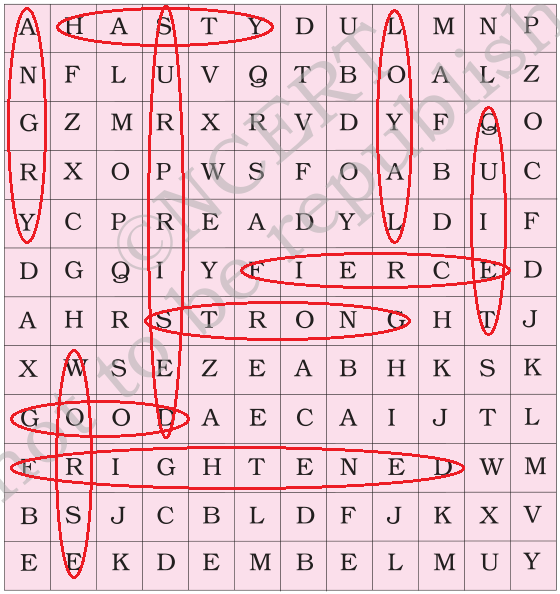
C. Wordsearch
• There are twelve words hidden in this table.
• Six can be found horizontally and the remaining six vertically.
• All of them are describing words like ‘good’, ‘happy’, etc.
• The first letters of the words are given below:

Horizontal: H R F F S G
Vertical: A W S F L Q

Word Finding Table Question Chapter 2

Answer

Word Finding Table Answer Chapter 2

Page No: 24

D. 1. Find the opposites of these words in the text above.

(i) ancestor — — — — — — — — — —
► descendants

(ii) wild t — m —
► tame

(iii) ancient — — — — — —
► modern

(iv) near d — — — — — t
► distant

(v) suddenly gr — — — — — — —
► gradually

2. Complete the following sentences.

(i) The dingo is  ———————————————————–—————  .
► the wild dog of Australia which looks and behaves like domestic dog.

(ii) Dogs were the  ——————————————————— animals
tamed by humans. The other animals tamed by humans
are  ——————————————————————————————
(Think and name some other such animals.)
► first, wolf, fox and coyote.

(iii) The New World refers to  ———————————–––—————  . Dogs were brought there from  —————————–————— .
► Ausstralia, Asia


Answer


The Kite

- Harry Behn

Page No: 28

Working with Poem

1.  List out the action words in the poem.
dive, dip, snaps, ——————, ——————, ———————, ——————, ——————
Find out the meanings of these words.

Answer

dive, dip, snaps, soars, rides, climbs, pulls, falls, run, blows, goes, flaps.

2.  Read these lines from the poem:
Then soars like a ship
With only a sail
The movement of the tailless kite is compared to a ship with a
sail. This is called a simile. Can you suggest what or who the
following actions may be compared to?

He runs like ——
► snail

He eats like ———
► horse

She sings like ———
► canary

It shines like ———
► diamond

It flies like ————
► bird